standard fontlarger font

The Tsum Project


everywhere there are stupas
and mani stone walls
In 2003, Lama Zopa Rinpoche was requested by Dukpa Rinpoche, a Bhutanese lama, to take care of his monastery and nunnery in the remote Tsum valley. Tsum valley is located in the northern border area of Nepal close to Tibet. The monks and nuns of these two places were in desperate need of help, being unable to support themselves any longer. Lama Zopa Rinpoche accepted the request immediately. He asked Tenzin Zopa, a disciple of the late Lama Konchok, to take on the task of finding support for the people of Tsum. Work started last year on improving the living conditions of the sangha in Tsum. People all over the world have shown keen interest in helping to make this possible and have donated generously.


Beyul Kyimolung - The Valley of Happiness


Chokang near Rachen Nunnery
In the remote borderlands of the high Himalayas, several valleys are said to be Beyul's - hidden or secret valley, that are only open to those with a very pure mind and heart. According to ancient scriptures, they were established by Guru Rinpoche, the 8th century Indian saint credited with spreading Buddhism into the Himalayas and Tibet. Hidden valleys are havens of peace, prosperity and spiritual progress, a place of refuge for believers. In the 17th century the Tsum valley that branches off the Buri Gandaki river towards the north of Ganesh Himalaya (Mountain) in upper Gorkha, was named Beyul Kyimolung.

Even non-Buddhists understand why Tsum is perceived as a blessed land. Perhaps one of Nepal's most beautiful valleys, it is cut off from the southern lowlands of Nepal by deep, forested gorges and swift rivers, and from Tibet in the north by snow-covered passes. The surprisingly flat valley floor provides for some 4,000 inhabitants of almost exclusively Tibetan origin.

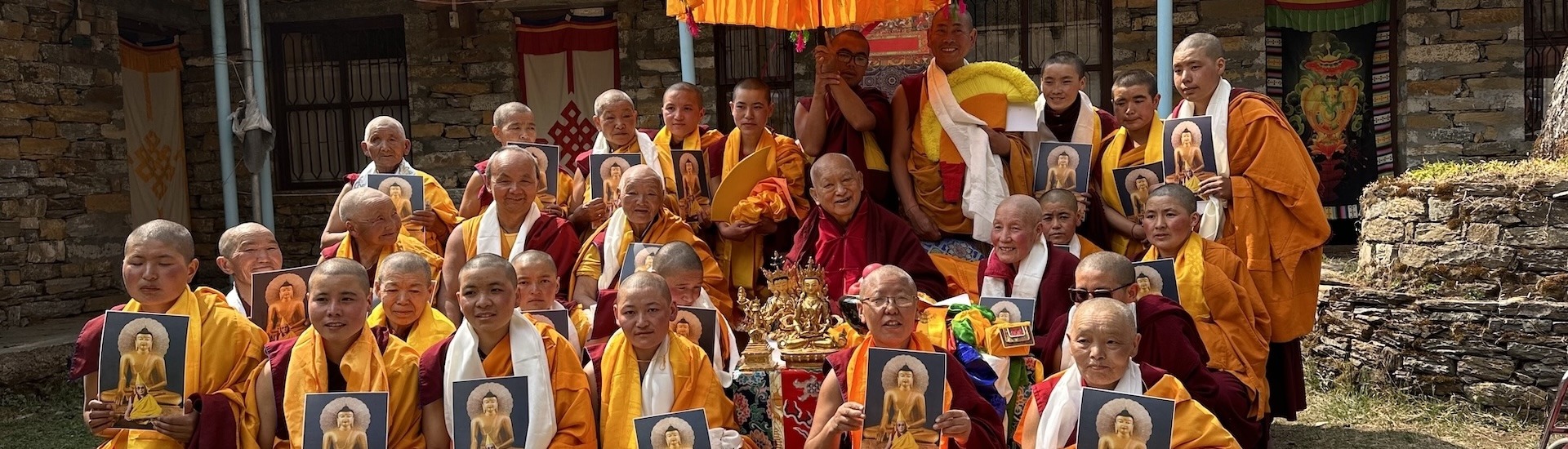
This is the home of around 100 monks and nuns at Mu Monastery and Rachen Nunnery.

donate now to help the sangha & lay people of the tsum valley

top of page ^

Mu Monastery


the young monks with their
teacher at Mu gompa
Thirty monks were living at Mu monastery when Geshe Lama Konchok was abbot in the 1970's. The three monastic practices (monthly confession and the two summer retreat ceremonies) were observed. During summer Geshe la would take the monks and nuns to some holy place in the valley such as one of the Milarepa caves and give teachings for several months, begging in the surrounding villages for food for his disciples.

Of the original 30 monks only 7 are still there, all of them 60 years or more. They spend their time in life long retreat, living in utmost poverty. One of them explains the situation like this:

"Before, it was very sad here; the walls were falling down, there was hardly any food, nobody came to make offerings or to support us. It seemed there was no hope." Because the monastery could not provide education, food and shelter, not one single boy or man had joined the monastery in the past 20 years.


Gyatso Rinpoche ordained many
young monks and nuns
Now, however, there is hope. Since the monastery was handed over to the care of Lama Zopa Rinpoche the living conditions already have improved a lot. Now there is a regular food supply. Caravans of yaks travel to Tibet every two months to get the necessary food supplies. Some ten young monks have joined the monastery and are studying Tibetan and learning prayers and rituals from a qualified resident teacher that joined the monastery from Sera University in India earlier this year.

top of page ^

Rachen Nunnery


After Rachen nunnery was founded in 1936 by Drukpa Rinpoche, many women joined. They are dedicated their whole life to spiritual practice under the guidance of experienced masters, and eventually the nunnery grew even larger than nearby Mu monastery.


a young girl waiting
to join the nunnery
Rachen nunnery is currently home and safe haven for around 80 nuns, with more young women registered to be ordained in the near future. The oldest nun is 75 years old, and the youngest is now 7 years old.

Many of the nuns come from poor families, and have suffered a life of abuse, beating and threats of forced marriage before joining the nunnery.

Being young and female in these remote areas means quite often to be a victim of abuse; one of the ways to escape this fate is to run away as far as possible, or join a nunnery, an accepted place of protection and refuge.


at prayers

There is an even greater interest in joining the nunnery now that the living conditions have improved. By entering the nunnery they have the chance to make their life most meaningful through the study of the Dharma. Taking on incredible hardships, living the simplest life they proceed steadily on the path to liberation.

donate now to help the sangha & lay people of the tsum valley

top of page ^

Living Conditions in Tsum


Light snow at Rachen nunnery
in March
Life in this remote, high altitude area is hard beyond imagination. The weather is cold all year around, and in winter, snow is piled high, making any movement impossible for more than two months. A fierce wind is a daily companion, making life difficult.

Before the monastery and nunnery were handed over to the care of Lama Zopa Rinpoche, most of the nuns and monks depended for survival on the kindness of their family or maybe some rare benefactor. Each person had to take care of their own food, and quite often they needed to go begging to the villages. As the families are also poor, they will give food only in exchange for work in the fields. A little bit of tsampa, and some hot water, sometimes black tea was the daily diet, supplemented in summer by some herbs, potatoes and vegetables.


kitchen where the meals for 90
people are prepared
The rooms and sleeping places were very simple; a mat or some stones or a sheet of wood in the floor. There are no tables, no beds, no carpets, not even glass in the windows. The roofs consist of slabs of stone over a simple beam construction and do not provide much protection from the elements. There were no toilets in the nunnery or monastery, and the hygienic conditions were very poor.

Improvements that have already
been made with your kind help:


The monastery and nunnery now offer food and medical care to all its residents. To cover the cost of food in the coming years, a food fund has been established.


a class room -
open air style
A teacher has been employed for Tibetan and English classes. The resident geshe of Mu gompa comes three days every week to the nunnery to teach on philosophy and supervise the memorizing of the prayers and rituals. A Tibetan doctor is available for basic medical care.

New buildings are cropping up - a new dining room, kitchen and storeroom has nearly been completed. The kitchen will have a fuel efficient fireplace for cooking, and a solar system for hot water.

Several classrooms are under construction now. All the rooms will have large windows with glass (quite a novelty in this area) and are built using a special stone construction with thick walls to keep the warmth in and the cold out. Special material will be used in the walls and ceiling to provide insulation from the cold and windy climate.


the new kitchen and dining room
The new buildings are the first step to upgrade the buildings in the nunnery. Next year the renovation and rebuilding of the actual accommodation will start.

Work on improving the infrastructure of the monastery and nunnery is being carried out continuously: Water pipes have been laid to bring clean water directly to the monastery and nunnery buildings, toilets are being built. A satellite telephone available to all the villagers has been installed to help with communication with Kathmandu and the neighboring valleys.

Difficulties in carrying out the work in a remote area.


Work in the Tsum Valley is restricted to the summer months, when the temperatures are more conducive to outdoor work.

Due to the Maoists controlling the access routes to the valley carrying the supplies in by porters is not possible. Therefore most of the building material and supplies has to be taken by helicopter - at great expense.

donate now to help the sangha & lay people of the tsum valley

top of page ^

Plans for the Future


The next year should see some more improvements in infra structure with the installation of solar lights, a must for the area, as there is no electricity supply. A solar company in Kathmandu kindly offered to help with the manufacture and installation of the solar lights for the monastery and nunnery by next year.

A hydroelectric scheme based on the river flowing through the valley could supply the whole valley with electricity and help with irrigation of the fields.


a woman with her child with
Chromosome 23 syndrome
During a recent health survey it was found that many women die quite young because of lack of maternal health care; children die from simple childhood diseases, accidents that elsewhere can be treated easily tend to cripple people for life. Many people are blind due to have cataracts and eye infections. Next year we will provide training in allopathic medicine to the traditional Tibetan doctors and organize regular health camps for special problems.

A hostel is needed near the nunnery to allow the children from other villages to attend school. The school and the hostel will continue to be under the care of the nuns of Rachen Nunnery.

An old people's home needs to be set up to take care of those with no family to care for them

Many needs, many plans - with all of us helping it will become a reality for the people of Tsum valley.

All the monks and nuns at Tsum and all of us involved in the project thank you from our hearts for your kindness and generosity. Without your help this would not have been possible.

We request you with folded hands to continue supporting our work, and save this special Dharma Jewel from extinction.

donate now to help the sangha & lay people of the tsum valley

top of page ^

A Personal Account of a Visit to Tsum


Tsum - the blessed valley
Ani Fran Mohoupt


The trip to Tsum was really, really wonderful. Tsum just felt like home. I know that sounds strange and probably many people talk like that, just blah blah. For me, arriving in Tsum and jumping out of the helicopter was like coming home.

This was a very powerful experience for me. And it was so incredible to see all the places I had talked about to various people in preparation for the project over this past year.

The Tsum valley is truly beautiful, a long valley, with the pathways lined with stupas and mani walls, the mountains dotted with the holy places of Milarepa and Guru Rinpoche, and the caves of yogis and yoginis who have achieved realizations in this valley for many hundreds of years.

The atmosphere is imbued with spiritual energy: the wish for Dharma practice comes nearly naturally, effortlessly - an amazing and transforming experience.

For the first few days we were staying at Rachen Nunnery, which is right in the center of the valley. We were very fortunate with the weather - not too cold, not too hot. Nighttimes a warm sleeping bag was in order. What it would be like in winter is hard to imagine.

The nuns at Rachen Gompa are so sweet; there are many young ones, and a very impressive group of older nuns that have done retreat and have a lot of knowledge. We attended a guru puja at Rachen Nunnery with all the nuns. The puja lasted for seven hours and I have to admit we all started to squirm on our seats a bit, while the nuns were sitting unperturbed, beautifully concentrating on the prayers. There was much laughter afterwards as we staggered out of the gompa with stiff legs.


The author,
after a long
walk up a
very steep hill.
From Rachen Nunnery we made a number of excursions in the valley, walking every day. It was sometimes quite tiring, with getting used to the altitude and the unaccustomed exercise. I am not fit at all, your proverbial couch potato. However the inspiring environment made up for all of it. Gelek Gyatso stayed in the lama room at Rachen, decorated with very beautifully painted murals, whereas the rest of the group stayed in the guest rooms.

Although living conditions are very tough at Rachen and Mu, one of the delightful things that the nuns and also the monks have created for themselves are the beautiful little private courtyards which provide shelter from the constant wind and trap the warmth of the sun, making it the perfect place for growing some flowers and vegetables, a welcome addition for their otherwise simple meals. Going from the courtyard to the outside area was like going under a cold shower - out comes the coat and the hat.

We visited Mu Gompa, a very a long walk of 7 hours for us, (the local Tsumpas do it in 4 hours). Mu Gompa was absolutely fantastic - everything you dream of when you image a remote monastery in a rugged valley. The monastery is built on a steep slope of a mountain. Again, it felt very familiar, specially the little house above the monastery where we stayed. Geshe Chokley, the resident teacher of both Rachen Nunnery and Mu Gompa, and the monks at Mu took excellent care of us.

We offered toothpaste, toothbrushes and soap to all the Sangha, and Frances and Chodak gave everyone a hygiene talk, which had everyone in stitches.

On the last two days we went for the longest and most beautiful walk along the mountain ridge far above the villages visiting all of Geshe Lama Konchog's holy places. It was really very moving to know this is where Geshe-la had meditated, where he did his practices, to see his cave, the small little house where he did his main retreat. The house was not in good repair, but a beautiful wild red climbing rose was in full bloom covering the house and garden.

During the ten days of our stay, we did a health survey of people at the monastery, nunnery and in various villages. Frances Howland, a nurse who works in Kathmandu, accompanied us. She organized the survey and held a clinic each day in the nunnery courtyard with Ven. Chodak, the head master of the school at Kopan, interpreting for her.

Interviewing people for the health survey was a real eye-opener to all of us about the poor conditions that people live in - there were always many people coming to see Frances; wherever we stopped there was a bunch of people already waiting as they had heard we were on the way. It made our progress very slow, but Frances could help many people even with thelimited medicine that we had brought with us.

We saw quite a few babies whose mothers had died in childbirth; there were even two sets of twins whose mother had died, leaving the father all alone to take care of them. Not an easy task.

Many people had eye problems, mainly from working in smoky kitchens. Many old people were blind from cataracts. There was really nothing we could do for them as they needed surgery. Cataracts are very common due to the high ultraviolet light exposure. Being blind or of poor eyesight is pretty terrible there as it means you can't go anywhere by yourself.

Gelek Gyatso Rinpoche suggested that organizing an eye camp would be very helpful for the local people. After approaching a leading eye hospital in Kathmandu, we now have a commitment from them to do an eye camp with cataract removal and lens implant early next year. Already more than 60 people have been identified as recipient for the lens implants.

Tsum remains an impression not just in the memory, but in the heart. From Kopan I look at Himal Ganesh, the snow mountain behind which the Tsum valley is hidden, and I am instantly transported back there, the smell of the wild garlic that the nuns collected, the constant roar of the wind, the hermitage clinging to the side of the mountain like a bird's nest, and the smile of people living there.

top of page ^

Health Survey in Tsum Valley
by Frances Howland


Health advisor Frances Howland visited Tsum in June 2005, to assess the health situation in the valley. During the visit she visited many villages in the area, interviewing a number of residents of the valley. Her report below gives a vivid image of the overall health situation, a result of extreme poverty combined with lack access to health facilities and and trained health care workers. The Tsum Project is working on improving this area of daily life for the sangha and lay community of the tsum valley.

Tsum Valley in Nepal
A State of Health

The objective of the visit was as follows -
  1. Conduct a health survey to assess the health care needs.
  2. To visit and assess existing health care workers and facilities.
  3. To provide medicines for the treatment of acute illnesses.
  4. To identify future health care workers who can be trained.
  5. To make a proposal for the next step.
A Health Assessment Questionnaire was developed and than filled out in Tsum by eighteen people covering the sangha community and nine villages.

Over one hundred sick people were seen and treated for a variety of illnesses. These varied from a lady we met on the trail who had just been bitten by a dog and another lady bitten on the face by a chicken to a young boy who had a severe fracture of his femur from a falling rock. He had been in bed unable to move for a number of weeks. He was transported back to Kathmandu and received treatment at the orthopedic hospital there, with the cost covered by the Tsum project. Without he help of the project, with no medical facilities nearby, he would have been crippled for life.

We met a number of fathers coping alone because their wife had died in childbirth from hemorrhage. Two men had baby twins to look after on their own.

Many of the older monks and nuns had high blood pressure and arthritic joint pains. Gastric problems and eye problems were amongst the most frequent complaints from all adults, while children mostly had intestinal worms, cough and cold and ear infections.

Many older people had cataract. An early success of this visit has been the organization of an eye screening camp during which reading glasses were handed out to those in need, and simple eye problems received treatment. A camp for removal of cataract and implantation of intra ocular lens for more than 70 people is planned to take place in Spring 2006.

Please see the complete report for details


top of page ^

How Can I Make a Donation?


Any amount of donation is welcome. To make a tax-deductible donation simply send your check in US dollars to FPMT Inc. and write Tsum on the check or provide your credit card details and mail to:


FPMT Inc.
1632 SE 11th Avenue
Portland, OR 97214-4702 USA


Click here to Donate On-Line

Your donation will go towards supporting the following activities

  • Building new rooms for the sangha at Rachen Nunnery and Mu Gompa
  • Providing the daily food for all sangha
  • Developing infrastructure (water supply and sanitation for nunnery and monastery
  • Develop educational facilities - teachers wages, education material
  • Provide continued health care and affordable medicines for everybody


Tsum is a project of FPMT Inc.
All donations made to the fund are tax-deductible within the United States in accordance with IRS Code article 501(C)(3).

Photos courtesy N. Dawson & F. Howland

top of page ^