The Tsum Project

everywhere there are stupas
and mani stone walls

Chokang near Rachen Nunnery
Beyul Kyimolung - The Valley of Happiness
In the remote borderlands of the high Himalayas, several valleys are said to be Beyul's - hidden or secret valley, that are only open to those with a very pure mind and heart. According to ancient scriptures, they were established by Guru Rinpoche, the 8th century Indian saint credited with spreading Buddhism into the Himalayas and Tibet. Hidden valleys are havens of peace, prosperity and spiritual progress, a place of refuge for believers. In the 17th century the Tsum valley that branches off the Buri Gandaki river towards the north of Ganesh Himalaya (Mountain) in upper Gorkha, was named Beyul Kyimolung.Even non-Buddhists understand why Tsum is perceived as a blessed land. Perhaps one of Nepal's most beautiful valleys, it is cut off from the southern lowlands of Nepal by deep, forested gorges and swift rivers, and from Tibet in the north by snow-covered passes. The surprisingly flat valley floor provides for some 4,000 inhabitants of almost exclusively Tibetan origin.
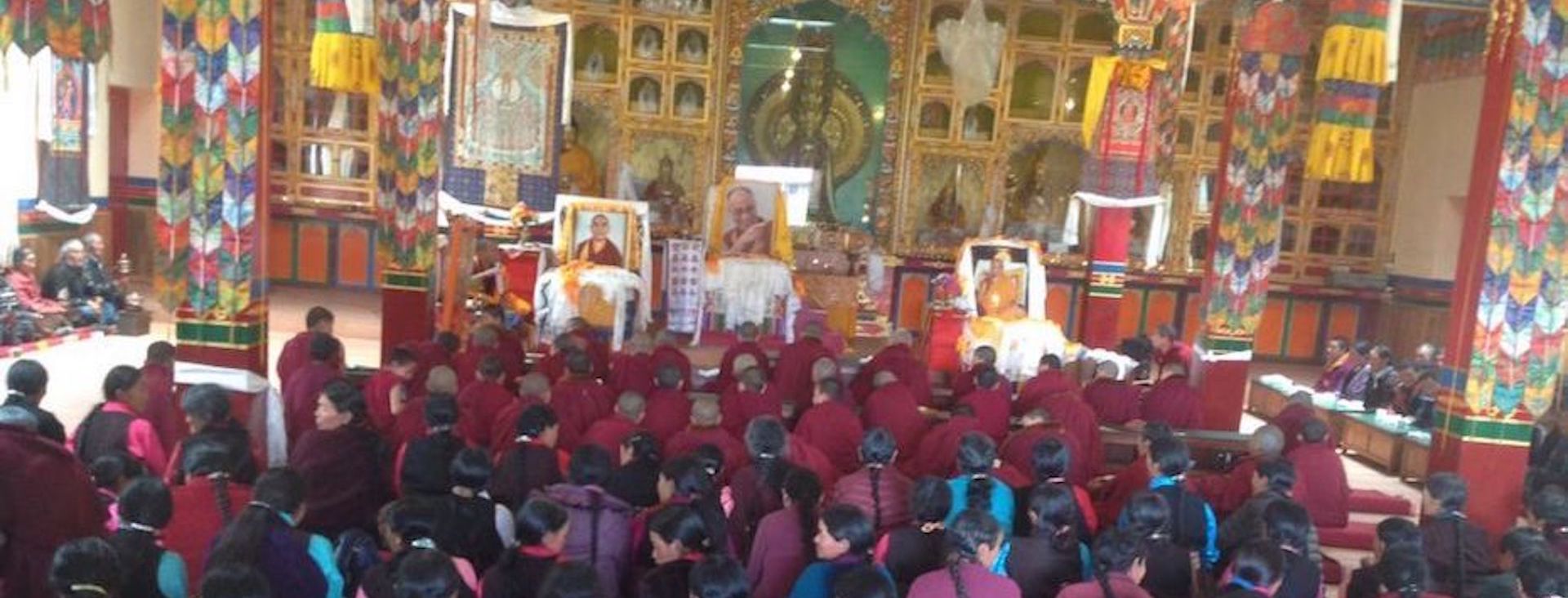
This is the home of around 100 monks and nuns at Mu Monastery and Rachen Nunnery.

the young monks with their
teacher at Mu gompa
Mu Monastery
Thirty monks were living at Mu monastery when Geshe Lama Konchok was abbot in the 1970's. The three monastic practices (monthly confession and the two summer retreat ceremonies) were observed. During summer Geshe la would take the monks and nuns to some holy place in the valley such as one of the Milarepa caves and give teachings for several months, begging in the surrounding villages for food for his disciples.Of the original 30 monks only 7 are still there, all of them 60 years or more. They spend their time in life long retreat, living in utmost poverty. One of them explains the situation like this:
"Before, it was very sad here; the walls were falling down, there was hardly any food, nobody came to make offerings or to support us. It seemed there was no hope." Because the monastery could not provide education, food and shelter, not one single boy or man had joined the monastery in the past 20 years.

Gyatso Rinpoche ordained many
young monks and nuns

a young girl waiting
to join the nunnery
Rachen Nunnery
After Rachen nunnery was founded in 1936 by Drukpa Rinpoche, many women joined. They are dedicated their whole life to spiritual practice under the guidance of experienced masters, and eventually the nunnery grew even larger than nearby Mu monastery.Rachen nunnery is currently home and safe haven for around 80 nuns, with more young women registered to be ordained in the near future. The oldest nun is 75 years old, and the youngest is now 7 years old.
Many of the nuns come from poor families, and have suffered a life of abuse, beating and threats of forced marriage before joining the nunnery.Being young and female in these remote areas means quite often to be a victim of abuse; one of the ways to escape this fate is to run away as far as possible, or join a nunnery, an accepted place of protection and refuge.

at prayers
There is an even greater interest in joining the nunnery now that the living conditions have improved. By entering the nunnery they have the chance to make their life most meaningful through the study of the Dharma. Taking on incredible hardships, living the simplest life they proceed steadily on the path to liberation.
How Can I Make a Donation?
Any amount of donation is welcome. To make a tax-deductible donation simply send your check in US dollars to FPMT Inc. and write Tsum on the check or provide your credit card details and mail to:
|
Your donation will go
towards supporting the following activities
|
||||||||||||||
Tsum is a project of FPMT Inc.
All donations made to the fund are tax-deductible within the United States in accordance with IRS Code article 501(C)(3).
Photos courtesy N. Dawson & F. Howland