 receive our newsletters
 join Friends of FPMT
FPMT Masters Program
Introduction | The FPMT Masters Program (MP) | Admission Requirements |
MP Curriculum | FPMT Masters Program Online | MP Guidelines and Support |
An FPMT Masters Program Report
The FPMT Masters Program in Buddhist Studies of Sutra and Tantra (MP), FPMT’s most advanced education program, is the unique design of Lama Thubten Yeshe. Developed by Geshe Jampa Gyatso at Istituto Lama Tzong Khapa (ILTK), Italy, it is the actualization of Lama Yeshe’s vision for a comprehensive Dharma education inspired by and adapted from the traditional Geshe Studies at the Gelugpa monastic universities.
The FPMT Masters Program’s mission is to provide a full-time, in-depth education for students of the Tibetan Mahayana tradition of Lama Tsongkhapa that emphasizes the integration of academic, practice, behavior, service, and training components. In addition to offering students a profound deepening of their Dharma understanding and practice, the program aims to provide the FPMT with highly qualified Western teachers of Buddhist theory and practice.
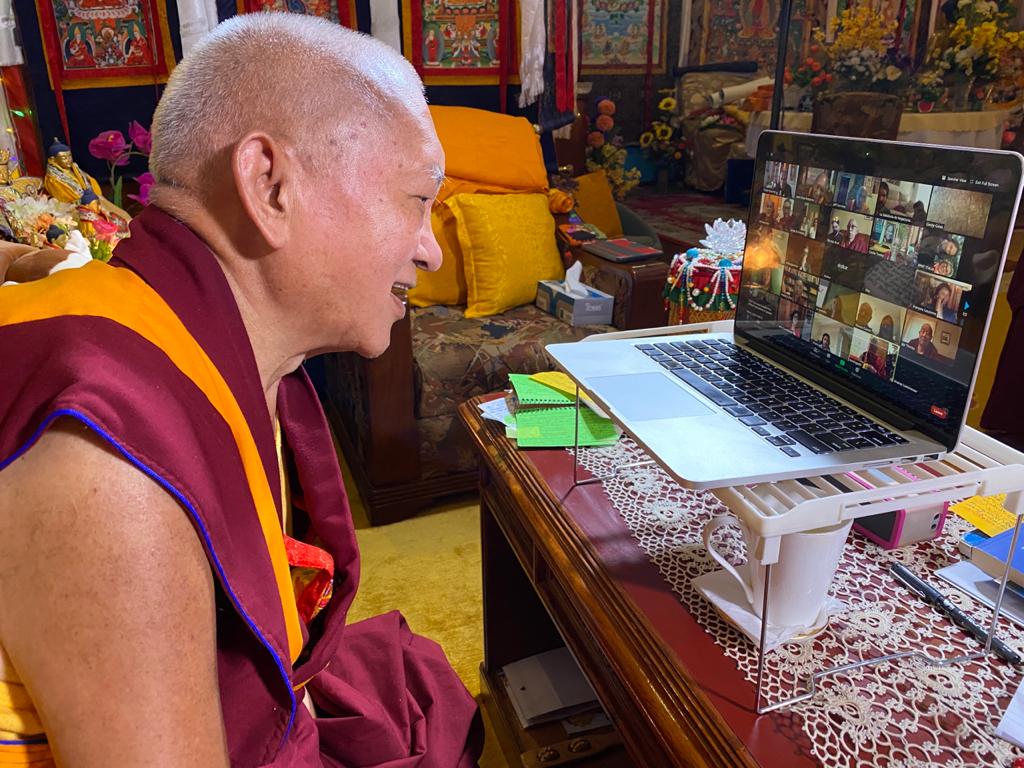
Lama Yeshe’s aim, his wish in setting up this program, was to enable people to study and come to a deeper understanding of the Buddhist teachings, both the vast and profound, as well as sutra and tantra, so that they could then teach other people. His purpose was also to enable each person to develop his or her inner qualities, such as perfect love and compassion, to complete the six perfections, and to achieve final enlightenment. In this way they would be able to help other sentient beings by leading them from cyclic existence to the great city of enlightenment. It was for this purpose that Lama Yeshe asked me to teach this program.
–Geshe Jampa Gyatso,
The Birth of the Masters Program, Mandala, 1999
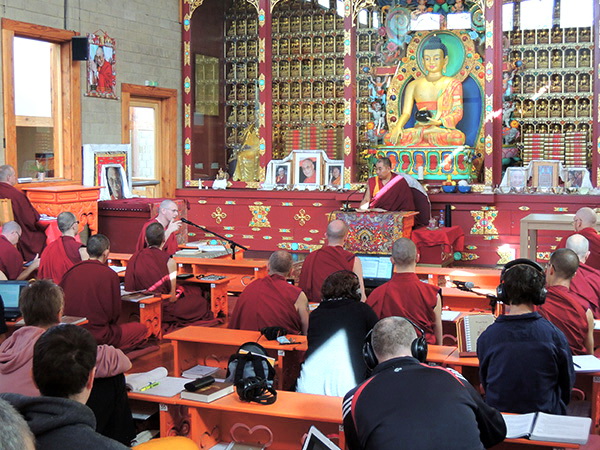
The full-time FPMT Masters Program offered by Geshe Jamphel, Nalanda Monastery, France
The Full-time FPMT Masters Program
History and Development: The first FPMT Masters Program, taught by Geshe Jampa Gyatso at Istituto Lama Tzong Khapa (ILTK), Italy, reached its successful completion in 2004. A second MP, taught by Geshe Tenzin Tenphel, Khensur Jampa Tegchok, and Geshe Jampa Gelek, was offered at ILTK from 2008 to 2014. It was completed in 2014 with a three-month review and final exams, and a one-year lamrim retreat, elements to complement the program that were added at Lama Zopa Rinpoche’s request.
ILTK’s third MP started early 2015 and, taught by Geshe Jampa Gelek. Chenrezig Institute in Australia offered the MP subject Middle Way from June 2012 to mid-2014. Nalanda Monastery in France offered its first FPMT Masters Program from 2013 -2020, with abbot Geshe Lobsang Jamphel as teacher.
In 2023 Istituto Lama Tzong Khapa’s fourth MP started; for February 2025 it has been welcoming students to join the second subject, Middle Way. ILTK’s MP is taught be Geshe Gelek. Nalanda Monastery’s second MP started in 2024, and is taught by resident teacher Geshe Jampa Gyaltsen – currently in its second year the program continues to offer the first subject, Ornament.
With the wish to implement the program worldwide, Lama Zopa Rinpoche has advised several centers to consider offering the FPMT Masters Program and has encouraged translation of the main texts into more languages. Several Spanish and French translations of the main texts and commentaries have since been completed or are in progress. ILTK offers the curriculum in English and Italian, and plans offers their MPOnline in Spanish as well; Nalanda Monastery offers their second MP English and in French.
What the FPMT Masters Program Entails: The full-time FPMT Masters Program consists of six years of study, three months of review with essay assignments, and one year of retreat. The program is taught by a fully-qualified Tibetan teacher assisted by experienced staff consisting of MP graduates and FPMT registered teachers. Familiarity with Tibetan is not required but can be helpful; the program is often preceded by an optional Tibetan-language course.
Daily teachings are complemented by tutorials, fortnightly quizzes, discussions and student presentations, student-guided meditations, and written exams every three months. A one-month lamrim retreat completes each of the sutra subjects. Students arrange their own year-long final lamrim retreat that concludes the program
Subject Completion and Program Completion: The criteria for subject completion include full participation in the academic, meditation, behavior, service, and training components with a minimum attendance in the various aspects of the program.
The MP subject completion card or an MP subject participation card is provided at the conclusion of each subject.
The MP completion card records the subjects that were successfully completed in case a student withdraws from the program before its conclusion.
The FPMT Masters Program is concluded with a three-month review with essay assignments, aimed at relating the subject matter covered during the program to practice, and providing integration and overview. An individual year-long lamrim retreat further ensures a deepening of students’ meditation experience and integration of the extensive studies.
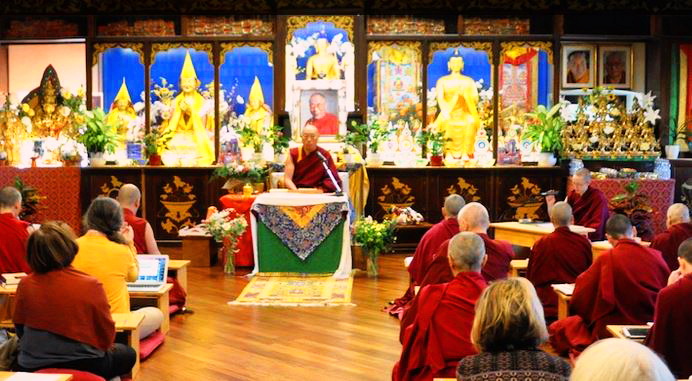
The full-time FPMT Masters Program taught by Geshe Gelek at Istituto Lama Tzong Khapa, Italy
The MP completion certificate, the highest educational achievement within FPMT, is issued by FPMT Education Services upon completion of all components of the program. Graduates are eligible to enter the FPMT teacher registration process; they can become FPMT registered teachers at foundational and in-depth levels.
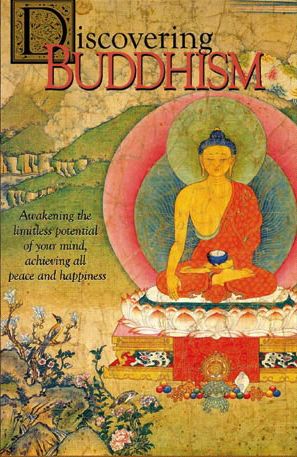
MP graduates have become teachers, interpreters, teaching assistants and tutors for the FPMT Masters Program and the FPMT Basic Program in centers around the world, and teach introductory and foundational level courses such as Discovering Buddhism and Exploring Buddhism. They actively participate in the further development of FPMT education programs. Several of them are translating MP and BP texts into various languages; others contribute to preparing MP and BP texts and materials for publication.
Admission Requirements
In addition to the prerequisites outlined below, center-specific admission requirements and an application procedure, including an interview, may apply.
General prerequisites: Having completed a systematic course of study such as Discovering Buddhism, Exploring Buddhism, the FPMT Basic Program, Maitripa College, or an equivalent program in another organization will count as an important factor for acceptance into the program.
Applicants should have at least one year of familiarity with the study and practice of the lamrim, including retreat experience, and have a thorough overview of the stages of the path as presented in the Tibetan Buddhist tradition.
The BP subject Stages of the Path offered as part of the BP in centers provides a detailed presentation of the lamrim. The subject STAGES OF THE PATH Middle Length Lamrim in FPMT’s BP Online includes retreat instructions and guided meditations.
Support materials for month-long lamrim retreat are provided through the FPMT Online Learning Center as part of BP Online. Several centers offer lamrim retreats from one to three months long as part of their BP and MP.
Specific Prerequisite Study: The BP subjects Mind and Cognition and Tenets are a mandatory prerequisite for admission to the FPMT Masters Program. While it is best to have studied these at a center, they can also be studied using BP Online through the FPMT Online Learning Center or as part of Nalanda Monastery’s and ILTK’s BP Online. Chenrezig Institute offers the subjects as BP homestudy packages.
Tantra Prerequisites: Additional requirements pertaining to tantra need to be fulfilled in order to study Secret Mantra and Guhyasamaja Tantra.
My experience of the FPMT Masters Program has been extremely positive. My mind has been changing so much. Participating in the MP is a never-ending work on oneself.
–MP graduate
I really enjoy the experience of living together with such an international group of students and practitioners who give much support to each other.
–MP graduate
Curriculum
Ornament for Clear Realization (Abhisamayalamkara) | Supplement to the ‘Middle Way’ (Madhyamakavatara) |
Commentary on Valid Cognition (Pramanavarttika | Treasury of Knowledge (Abhidharmakosha) | Grounds and Paths of Secret Mantra | Guhyasamaja Tantra
The FPMT Masters Program curriculum consists of six subjects, together representing the essential teachings of sutra and tantra in the Gelug tradition. The subjects are taught on the basis of standard texts and commentaries.
Ornament
The Ornament for Clear Realization (Abhisamayalamkara) by Maitreya is a commentary on the Perfection of Wisdom (Prajnaparamita) texts that serves as a support for understanding the profound teachings on emptiness. It includes a detailed explanation of the spiritual paths of hearers, solitary realizers, and bodhisattvas, together with their clear realizations and abandonments on the various paths. It discusses the precepts and methods for obtaining the meditative stabilizations, clairvoyances, signs of irreversibility, and qualities of buddhahood, including the thirty-two signs and eighty exemplifications, the four buddha bodies, and omniscience.
Maitreya’s Ornament is explained on the basis of The Commentary: Clear Meaning by Haribhadra and The Explanation: Ornament of the Essence by Gyaltsab Je.
Middle Way
Supplement to the ‘Middle Way’ (Madhyamakavatara) by Chandrakirti explains emptiness as presented by the Madhyamaka-Prasangika system of tenets. The main body of the text consists of ten chapters, each one associated with one of the ten perfections and one of the ten grounds of a bodhisattva. Study of this text leads to an understanding of great compassion and how it serves as a cause for generating the mind of enlightenment (bodhichitta). This text also sets out the various levels through which one proceeds to the attainment of the completion of all ten perfections and enlightenment.
Chandrakirti’s Supplement to the ‘Middle Way’ is explained on the basis of his auto-commentary Explanation of the “Supplement to the ‘Middle Way’” and Lama Tsongkhapa’s Illumination of the Thought.
Valid Cognition
Dharmakirti’s Commentary on Valid Cognition (Pramanavarttika) is a fundamental treatise on Buddhist logic and epistemology, presenting the reasons that prove the possibility of past and future lives, liberation, buddhahood, and so forth through valid cognition (pramana).
The teachings on Valid Cognition will focus on logical inference and the establishment of valid authority, and are presented on the basis of Gyaltsab Je’s Elucidating the Path to Liberation.
Treasury
Treasury of Knowledge (Abhidharmakosha) by Vasubandhu is a vast description of the outer and inner world according to Buddhist cosmology—the various types of migrating beings, the six realms and their causes, the afflictions and their antidotes, minds and mental factors, the various types of spiritual practitioners and their paths, and the knowledges, concentrations, and absorptions.
The teachings on Treasury will focus mainly on the chapter presenting actions (karma) and afflictions and are based on the First Dalai Lama, Gendun Drub’s Clarifying the Path to Liberation.
Secret Mantra
Grounds and Paths of Secret Mantra is studied on the basis of either Kirti Losang Trinley’s or Ngawang Palden’s condensed explanations of Lama Tsongkhapa’s Great Exposition of the Stages of the Path of Mantra. The most important features of the four classes of tantra as well as the initiation procedures and particularities of deity yoga related to each class are presented, with emphasis on the spiritual grounds and paths of highest yoga tantra.
At the discretion of the teacher, the study of Grounds and Paths of Secret Mantra may require having received a highest yoga tantra empowerment from a qualified teacher. This entails taking the bodhisattva and tantra vows and the daily commitment of the Six Session Guru Yoga.
Guhyasamaja Tantra
This highest yoga tantra commentary offers a thorough explanation of the generation and completion stages of Guhyasamaja. The presentation of the generation stage includes an explanation of the visualization and generation of the mandala and deities and how to carry death, the intermediate state, and rebirth into the path. The presentation of the completion stage discusses the six branches: the isolation of body, isolation of speech, isolation of mind, illusory body, actual clear light, and the union of clear light and the illusory body.
The tantra of Guhyasamaja is studied on the basis of the generation and completion stage commentaries by Aku Sherab Gyatso, Sacred Words of Akshobhya and Nectar From the Mouth of Akshobhya. Lama Tsongkhapa’s detailed commentary on the completion stage, A Lamp to Illuminate the Five Stages, is used for reference.
In order to study this subject, one needs to have received the highest yoga tantra empowerment of Guhyasamaja from a qualified lama.
The FPMT Masters Program Online
In addition to written course materials and texts, audio and / or video recordings of the teachings, and of review classes, the online MP includes forums supervised by the tutors, and online quizzes and exams. The online course runs parallel to the residential program, A minimum of 20-25 hours a week are needed to reach a good level of understanding of the material studied.
ILTK’s MP Online will be offered in English, Italian, and Spanish, from 2023-2028. . Nalanda Monastery’s MP Online will be offered alongside their residential FPMT Masters Program from 2024-2029 in English and in French. Chenrezig Institute’s MP level Middle Way course is available as a homestudy package.
Admission Requirements: If MP Online is offered including the certificate option, the admission requirements are the same as for the full-time program. Studying the program at home without the support of a daily structure and Dharma environment is demanding. It is essential for students to have a sufficient background of preparatory study, a well established daily meditation practice, and sufficient retreat experience to conduct short and longer individual retreats.
Subject Completion and Program Completion: The criteria for subject completion include full participation in the quizzes and passing the exams, fulfilling the behavior requirement, and fulfilling the meditation requirement.
MP subject completion cards and MP participation cards are provided at the conclusion of each subject. The FPMT Masters Program Homestudy completion card provides a record of the subjects that were successfully completed in case a student withdraws from the program before its conclusion.
Students who successfully complete all subjects qualify for participation in the three-month review with essay assignments. Upon completion of an additional one-month lamrim retreat, students will be awarded the FPMT Masters Program Homestudy Certificate.
Graduates of MP Online are eligible to apply for FPMT teacher registration at the foundational level. Once registered, they can teach Discovering Buddhism, Exploring Buddhism, and introductory courses in FPMT centers upon request. They can also contribute in various other roles, for example, as interpreters, teaching assistants and tutors for the FPMT Basic Program or as translators of texts and course materials.
Guidelines for Implementation and Support
FPMT Education Services extensively supports centers that are implementing the FPMT Masters Program by assisting with planning and scheduling, and in the preparation of publicity. The MP materials web page provides texts, translations, and collated study materials from previous MPs, such as transcripts, charts, and review class notes. The MP Guidelines for Implementation clarify requirements and describe all components of the program in detail. Regularly updated, they consolidate experience and program development.
An FPMT Masters Program-Lite (MPLite) has been designed for centers interested in offering MP subjects in a non-residential setting and without the rigor of the full-time program. The MPLite offers centers the option to use the materials developed by the full-time program in a structured way, and with suggestions for adjusted completion requirements.
For more information, please contact the FPMT Masters Program coordinator.