DONATE
  • join our email list   

Additional information

"The activities that Lama Yeshe performed are the activities of all holy beings."

Geshe Jampa Tekchok

Lama Yeshe was born near Lhasa at a place called Tölung (Upper village), which was also near where my family lived. Lama's family was of an average size, his mother and father had a strong faith in dharma, and Lama Yeshe also showed much interest in dharma when he was a small boy. Several of his brothers became geshes as well. His parents had a mixed farm where they grew crops and also kept animals.

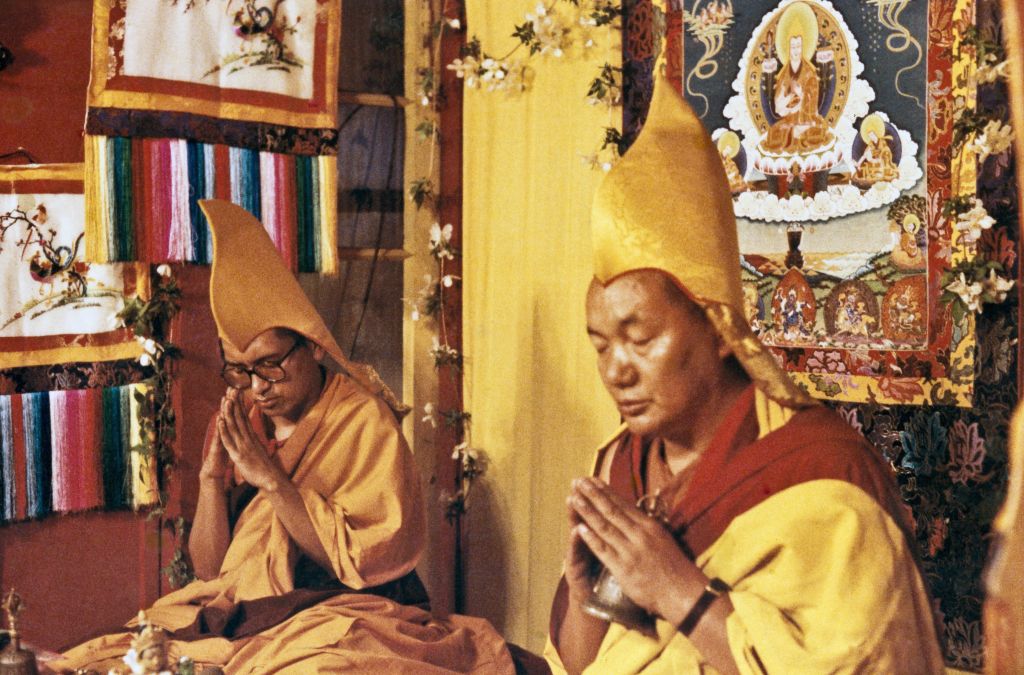
With Geshe Tekchok, Manjushri Institute. 1979 Lama Yeshe was ordained when he was about seven or eight years old. In the beginning the young monks learned the alphabet and memorized the daily prayers such as tung-shag and the Twenty One Praises to Tara. They also memorized the important texts to be studied in depth later on.

Lama began studying the Geshe subjects when he was about twelve years old. At Sera the year was divided into several terms of intense study with shorter breaks in between. During a typical day in the study time the monks would wake up early and make prostrations together in the stone courtyard. Then they would do morning puja together after which they would break up into different groups. Some would do debating, others would recite texts such as the Prajnaparamitasutras, and others would be reciting the Heart Sutra and Twenty One Praises to Tara many times. Mostly, this time was spent in discussing and debating the subjects they were studying. They would do this in their own rooms, in small groups.

Tsampa and tea had been taken during morning puja. It was again served after the debating session when all the monks would again assemble for puja. They would recite the Heart Sutra and any pujas which had been requested by others.

At midday there was another class for debating, after which all the monks again came together to recite the Heart Sutra. After that there was a break during which people were free to do as they wished. Many would go to different lamas to receive explanations on the teachings.

The evening brought another debating class. At the beginning of this class they would recite the Heart Sutra very slowly, meditating at the same time. Debating lasted a long while. This was followed by a short break and then the night class, dam-ja. began. During this class all the monks would ask questions of one or two monks who would sit in front. After this class the monks would retire to their own rooms where they would review the discussions held during the day, meditate, study, or sleep. So this is a typical day during a term of Geshe Studies.

Lama Yeshe followed the whole program without missing any terms and he did very well at his studies. All those who were following the course to become Geshes did the same things.

During the break periods in between terms some of the monks would stay in their own places, memorizing texts, others would visit teachers for special instruction, some would receive disciples to give teachings themselves. Also it was a time to reflect on all the subjects they had been studying and debating. Some of the monks would leave their rooms at the monastery and go to high places, huts and caves in the mountains where they would read, memorize, reflect and meditate upon the teachings.

When the monks studied the Abhisamayalamkara there would be classes lasting the whole night, every night. Usually the monks would stay up one night and sleep the next night, while others who had slept the first night would attend the class on the second night. During the day, even after staying up all night, they would still attend the entire program as already mentioned. During the all-night classes they would debate or the whole group would ask questions of one or two monks as before (dam-ja).

When the monks studied Madhyamakavatara they would spend two years staying up all night to debate. So three years were spent in this way. Lama Yeshe followed the whole program.

In the winter season there was a term called Jam-kön-chö. All the monks of Sera, Ganden and Drepung monasteries would gather together to debate subjects such as the Pramanavartika at a place called Jam—it had been blessed by Manjushri. The monks were not obliged to go but Lama Yeshe always attended. There was just a courtyard out in the open. They would build a wall of stones to block the freezing wind, and they would sleep in their own rooms back at Sera.

During the period in between terms some monks would stay up every night reciting texts. Lama Yeshe used to do this. Altogether he spent twelve or thirteen years doing the rigorous Geshe Studies - learning the essential texts. He also attended the teachings of Kyabje Ling Rinpoche, Kyabje Trijang Rinpoche and His Holiness the Dalai Lama given during the times between terms.

Also, it was the custom for monks of the higher classes to act as tutors for those of the lower classes. Lama Yeshe spent a lot of time teaching and answering questions in this way. Lama Yeshe’s own classmates included some high lamas and others who were very good in philosophical understanding and debate. Lama was a member of a very distinguished class.

After all this the Tibetans came to India. At first they stayed at a place called Buxa, members of all three Gelugpa monasteries came as well as of the four lineages of dharma in Tibet. At Buxa they studied Vinaya and the Abhidharmakosa. Lama Yeshe studied these texts and also reviewed the Madhyamakayatara. Abhisamayalankara and Pramanavartika texts already studied in Tibet. Also at this time Lama studied subjects such as poetry, grammar and the art of composition and writing. There were special teachers for these subjects.

At Nalanda Monastery, September 1983. At Buxa Lama Yeshe also received many oral transmissions and initiations from His Holiness Song Rinpoche. He also learned the Gelugpa's 'uncommon' prayers and tunes and other rituals. And he learned Hindi. He also learned some English from Lama Zopa, who had lived in Dalhousie.

Lama Yeshe and Lama Zopa met Zina and then Max Mathews. Their karma took them in the direction of Nepal where they began to meet many Westerners with whom they had a karmic connection from past lives. Lama Yeshe was still dependent upon Lama Zopa for speaking English. They established Kopan monastery and began a community of monks for the Sherpas, Manangs and Tibetans. At Kopan they set up a system of education just as in Tibet. The number of monks grew to about one hundred. These monks also received teachings in English and on Western subjects such as mathematics, science and geography. Lama Yeshe and Lama Zopa also established Lawudo gompa where the normal monastic activities of Nyung-ne, pujas on the tenth and twenty-fifth of the month and so on, were performed.

Meanwhile, the Lamas began giving teachings to Westerners. They also started to give Nye-ne, Genyen and Getsul vows to Westerners. Lama's Western disciples invited him to teach in the West where he made contact with many more people and from there the centers of the FPMT began. Lama Yeshe established centers in so many countries and he also ensured that they had good teachings with geshes and translators so that dharma was being taught continuously.

Lama Yeshe and Lama Zopa then spent half of each year visiting the centers and giving teachings and inspiring the students. They also invited high Lamas such as Khenpo Geshe Legden. His Holiness Song Rinpoche and His Holiness the Dalai Lama to visit the dharma centers.

Among Lama Yeshe's thousands of disciples about one hundred have received ordination as getsul or gelongs, and the majority took genyen vows.

From my side I have nothing to say about whether Lama Yeshe was a buddha or a bodhisattva. It is possible that he is a special being. I cannot say that he is not. There are many manifesations of buddhas and bodhisattvas in the aspect of lamas, ordinary monks and nuns, and lay people. They manifest in this way to benefit sentient beings.

Lama Yeshe's activities were very vast. He did all of these extensive actions with the title of an 'ordinary monk.' His works were very beneficial for others. Through Lama Yeshe's efforts dharma. which is benign for sentient beings, has flourished. The activities that Lama Yeshe performed are the activities of all holy beings.

From my side, Lama Yeshe was a friend. I felt very well.

back to top ^


"It seemed as though he was willing to do anything to help people overcome their limitations and unhappiness and experience their higher selves."

Jonathan Landaw

I first met Lama Yeshe in January 1971 at Bodh Gaya: the site of Shakyamuni Buddha's enlightenment. it was my first trip to India and I had just arrived a few days previously together with my close childhood friend, Alex Berzin. I had come to Bodh Gaya to spend a few days before traveling around South India. Shortly after my arrival I learned that a Tibetan lama, newly arrived from Nepal, was going to hold a question and answer session for interested Westerners at the Tibetan Temple. This would be my first opportunity to meet a Tibetan lama and, since I'd come to India expressly to study Tibetan Buddhism, I was naturally very interested in what I would find.

At the appointed time a large group of us assembled in one of the upper rooms at the temple. And after a while, accompanied by a young American couple, a Tibetan monk came into the room, smiling broadly. Although there was nothing special about his physical appearance, this first sight had a galvanizing effect upon me. I felt that something in my heart - something that I had never known existed before - had suddenly been aroused. I remember feeling at that time that it was as if my heart were filled with iron filings and an electromagnet had just walked into the room!

Then he began to speak. To say that his English was broken would be generous: his vocabulary was extremely limited, his pronunciation strange and his grammar anarchistic. Yet I felt at the time that I had never experienced such deep communication with anyone ever before. When he spoke about a warm peeling' it took my brain a few minutes to figure out what he was talking about, but my heart understood immediately. Indeed, by the time the hour was up, I was experiencing a warm feeling the likes of which I had never known.

There were two deep impressions I carried with me after that first meeting. The first was that this man - whose name I did not know - would be a completely trustworthy guide along the path to spiritual development. The second impression, perhaps even deeper than the first, was of his familiar and easily recognizable human qualities. This monk was certainly no distant, austere and unreachable being but rather had all the earthly human qualities I treasured. This came as a great relief to me since I had harbored a suspicion that spiritual evolvement according to Buddhism might entail emotional coldness. This monk's warm and humorous presence refuted this fear immediately and completely.

Two and a half years passed before I saw Lama Yeshe again and during that time I often wondered if my first impression of him might not have been exaggeratedly romantic. Perhaps my immediate attraction to him had more to do with my arrival in such a strange and exotic place as India than it did with any qualities that this lama actually possessed. But at my second meeting, at Tushita at Dharamsala, I received the same overwhelming impression of heightened awareness and human contact that I had at t the first. This time I met him in private. At the end of our meeting he stood up, held my hands in his and, as warm energy poured into me, the features of his face seemed to rearrange themselves into the perfect symmetry of a Buddha.

During the thirteen years I was fortunate to know Lama Yeshe, I had the opportunity of observing him in many situations. And during all that time I never encountered anything to challenge the first impressions I received of him. His warmth and humor seemed inexhaustible and his devotion to others and to the teachings of dharma never faltered, even when his health was apparently failing. It seemed as though he was willing to do anything to help people overcome their limitations and unhappiness and experience their higher selves. In pursuit of these aims he was often outrageous! He would sing, dance, tell jokes, and even flirt if it would help establish contact, yet at no time did he overstep the bounds of the strictest self- discipline.

If, out of all the many facets of his ebullient personality, I had to choose one that was most characteristic of Lama Yeshe I would have to pick his constant urge to make deep contact with others. I once saw him act out in pantomime, to a Spanish woman who knew no English and who was worried about her son and his family, his assurance to her that he himself would keep an eye on them and make sure they were well. And his urge to communicate clearly was not limited to his personal contact with others. I have often seen him reject the standard commentarial interpretations of a particular text he was teaching in favor of something more direct and immediate. When dealing with a particularly difficult problem of Buddhist philosophy, he would often say, 'Concerning this subject, the Pransangikas say this and the Chittamatrins say that, but the best way for you to understand it is like this.' No matter what subject he was discussing, he made sure that all of his listeners had something personal and practical to take away with them.

There are hundreds of stories that could be told about Lama Yeshe, yet anyone who ever saw his smile, heard his laughter and listened to his teachings already knows the essence of them all. Some people used to refer to him as the 'Thank you Lama' because while he was devoting himself to others he never stopped thanking us for receiving his warmth and generosity. For me, it is impossible to enumerate much less to repay the motherly and fatherly kindness that he showed me. Thank you, Lama.


back to top ^


"He showed what a difference a single person can make."

By Jeffrey Hopkins

Lama Yeshe provided a means of entry into the study and practice of Tibetan Buddhism for many, many persons throughout the world. Clearly, he had strong dedication to helping others so that they could partake of the richness of Buddhist teachings as known in Tibet. That commitment was not self-arisen or an uncaused gift, but a result of training - an imprint of his mind's being affected by doctrines of love, compassion, and altruism. His vast activities in helping people from a number of walks of life are a measure of the greatness of his training and of the doctrines that inspired him.

Given the dictum of the first of the Four Reliances, 'Rely not on the person; rely on the doctrine,' it is appropriate that at this time of his passing (and of the passing of so many other great Tibetan and Mongolian teachers) we look to what made his greatness. His magnificence was the result, not of a special innate endowment, but of special hard work at embodying and expressing altruistic attitudes. Thus, our learning those teachings within working hard to embody and express them is, it seems to me, the most suitable form of memory of him.

Given the variety and complexity of the Tibetan teachings and the present crucial point in their history, it is important that we realize how much responsibility for the continued availability of this teaching even one person can assume. It is clear that Lama Yeshe did not wait for others to work at incorporating the doctrine; it is clear that he did not view the dharma as a spectator sport, watching someone else and then second-guessing. Instead, it is clear that he decided that he would do what he could do. He showed what a difference a single person with sincere motivation can make. Even those who, like myself, were not formal students of Lama Yeshe, still have much to learn from his activities of compassionate energy.


back to top ^


"We should be very harmonious and try to help each other. We should ask: How can I help? How can I serve? What is the best thing? What is not good?."

Geshe Sopa


I didn't come here to give a speech. I came here to participate in the ceremonies for Lama Yeshe, and Lama Zopa requested me to say a few words of advice to you as I have been Lama's teacher for a long time. We have known each other for a long time as teacher and student, in Tibet, since he was a young boy, and we have always had a good relationship, since then right up till now. I have nothing much to say, just a few words, maybe.

Geshe Sopa and Lama Zopa Rinpoche at cermonies for Lama Yeshe. During these past years Lama Yeshe has done so much beneficial activity for so many people, especially in the West. In fact, these two teachers, Lama Yeshe and Lama Zopa, have done such a wonderful job. The result is everywhere in the West - so many centers, so many students who follow the teachings seriously.

And because of all this activity the students have such a wonderful opportunity to meet other teachers, to receive many, many instructions and teachings. Even in Tibet we didn't have that kind of opportunity! To have high lamas teaching all the time and giving high initiations, to have all this available is very, very rare.

So, when I see what has happened in the past few years, it makes me really happy, and I feel such admiration for Lama Yeshe and Lama Zopa and for their students. It is very difficult to follow a new religion coming from a different culture. It is not easy to accept and to follow deeply, but I see so many of you people are doing so, enthusiastically and with faith. I am really amazed when I see all this, and I rejoice and am very happy.

Now, Lama Yeshe has passed away. While he was alive I think he always wanted to go to the West. It began with a small group in Nepal, then spread everywhere like fire. People would go back to their countries and they wanted to continue the same kind of tradition, the same kind of teachings, the same kind of atmosphere. And so for their benefit Lama Yeshe sent so many teachers. And so the teachings spread everywhere.

We have a saying in Tibetan that means that the dharma, the teachings, is the only medicine to completely cure misery and suffering. So, if the teachings survive and spread everywhere there is great benefit to everyone, the most excellent way to serve the people. The dharma only leads to the highest goal, happiness, it does not bring suffering or turmoil; it is the cure for suffering.

This was Lama Yeshe's goal, and when he saw the teachings spreading he was very, very happy. He was happy when he saw all the places and the people following the teachings, people dedicating themselves and making sacrifices to help develop the teachings, not for themselves only but for the benefit of others. I can see this. I can see so many people really dedicating themselves towards the spreading of the teachings. All the centers, the people working to fulfill the wishes of the teacher. That is a wonderful thing, and I admire all these people, all of them. So now, Lama Yeshe has passed. But everybody hopes that the people, his students, will still continue to follow him and his teachings and try to develop the organization that he started in a right and proper way towards the goal that he wished to accomplish. His favorite son, Lama Zopa, is alive and here still and he can continue to help you people and teach continuously. I hope you will seek teachings and advice from him in the same way as from Lama Yeshe.

One of the main goals of the Buddhist teachings is the development everywhere of peace and calmness. So, we people should try to develop and practice the teachings. There are so many different traditions, different levels, and you should follow whichever without too much mixing. They all have the same goal, but sometimes mixing them just doesn't work, like trying to get somewhere by car, then airplanes, then walking; mixing the systems is sometimes not a very good thing. So, if one follows a pure system then one will accomplish one's goal.

There are many students everywhere at all the centers that Lama Yeshe and Lama Zopa have established. It is so important to be very, very friendly towards each other, like children of the one spiritual father. We should be very harmonious and try to help each other. We should ask: How can I help? How can I serve? What is the best thing? What is not good?


We humans, we have such intellect; we can do so much if we think and examine in the proper way. If we have an earnest attitude towards whatever has to be done then we can accomplish an enormous amount. Because of our intellect we can also accomplish evil; humans are more powerful than any others. We should use our human intellect to achieve a spiritual goal, for the benefit of others and ourselves.

Therefore I think that harmony between religious friends, religious brothers and sisters is so important. To feel that we can help each other, to find the best way to help, that is one of the goals.

Of course, human beings sometimes make errors. When we see errors, problems, we can try to solve them. We can help each other to solve our problems, like brothers and sisters taking care of each other. This is so important. This way, we will be helping to continue Lama Yeshe's projects. Already you will have experienced this generally, so we should continue to do, dedicate ourselves towards this goal: that would be a very excellent thing.

Lama Zopa Rinpoche at cermonies for Lama Yeshe. Of course, I know that so many people are working very hard and very earnestly to achieve his goals; putting their bodies and minds towards these goals. I hope everybody will follow in the same way to fulfill Lama Yeshe's wishes. Each group should concentrate on doing whatever they can, each in their own way, developing. They should do things in the best way they can without interrupting others, but also to share good ideas and to help each other, that would be very good.

So, Lama Zopa is still here. Several yea ago Lama Yeshe was with me in Madison and he was visiting hospital and having serious examinations and tests to decide whether or not to have the operation on hi heart at that time. Anyway, then, I knew that he had the strong, strong wish to take care of Lama Zopa. Lama Zopa is very young. However, even though he is young he is one of the young lamas who is special He is a great practitioner, he has studied seriously and practiced seriously, and c teach other people. I think everybody see this. Anyway, Lama Yeshe wanted him to be successful, to be beneficial continuously.

It is important to help Lama Zopa; certain areas he needs help. Already so people are a little bit worried. However, should keep it in mind. His activities everywhere are great, sowing seeds everywhere for the development of the wonderful spiritual teaching that is most beneficial to sentient beings.


back to top ^


"Now here is a real yogi!"

Brian Beresford

I would like to tell a story. I had the good fortune in 1978 to attend a private discourse given by His Holiness the Dalai Lama on Heruka tantra. There were only three Westerners there, the rest were abbots and tantric monks. His Holiness came to particular points in the text where he would stop and ask a question. This would happen several times and usually His Holiness would get an answer from the abbots. However at one particular point, His Holiness was not satisfied with the answers he got. He would go to this abbot, then that abbot, sometimes chiding them for not knowing the answer. Lama Yeshe was sitting four rows from the front. I could see him from where I sat. He shyly put up his hand, blushed red, and said 'Perhaps Your Holiness means this, that.' 'Yes! Exactly!' said His Holiness. 'Now here is a real yogi!'


"When we were young together, I had no idea of what was going to happen. No one ever dreamed that things would turn out as they did. But it happened."

Geshe Jampa Gyatso


Lama Yeshe was thirteen and I was sixteen when we first began studying together in the same class at Sera. We knew each other in class at that time but were not yet friends outside of class. Lama Yeshe was known for his humility and his loving mind towards others, even then. Lama lived at that time (and until he had to flee from Tibet) with his uncle, who was his gegen (teacher). Who provided him with food and clothing and instructions about the monastery.

With Geshe Jampa Gyatso and Geshe Jampa Wangdu, Tushita, Dharamsala, 1983.Sometimes monks who were very good students were given the very special privilege of debating in front of the entire assembly of Sera monks. The monastery chooses the subject that one must debate. But one can decline if one so wishes. When Lama was still quite young, he was honored with this opportunity, and was given a particular chapter about Maitreyanath to debate on. There is said to be something very auspicious for the monk who receives this debate subject, since it concerns the coming Buddha. But Lama Yeshe declined to debate this time.

Lama Yeshe and I studied in exactly the same way (the same texts, etc.) until we both had to flee Tibet. The only difference was that we had different teachers. According to the monastery rules, monks are not allowed to go and listen to teachings in places other than in their own classes. Nevertheless, Lama Yeshe sometimes went to listen to other teachings anyway.

Lama Yeshe especially enjoyed reading the verses and songs written by great yogis about their experiences. Lama, another monk named Jampa Thinley (who is now dead), and I were very good friends by this time. Lama would go into Jampa Thinley's room and lock the door and read the songs of great meditators, or their biographies. He and Jampa Thinley would open the door only for me, not for anyone else.

When we were together in the class on Paramita (Abhisamayalankara). Lama Yeshe and I both developed huge sores like carbuncles on our cheeks. Very painful. But we both went to debate anyway. At this time Lama Yeshe had to take the position as the respondent (the debater who is seated). When he would become excited and answer loudly during the debate, his boil would burst open, and pus would spurt out, and Lama would cry from the pain. Sometimes we would lament our sickness together, and start to cry about our bad karma, since no one else had unbelievably painful boils like we had. The doctors could not cure them at all with their medicine. Then we met one monk called Ate. He used mantras, reciting and blowing on our cheeks. He cured our sores in just a few days. When he would be treating us and saying mantras and blowing, our minds would feel very happy and we would feel a certain coolness from his breath.

One time, Lama Yeshe had the idea to make two debating groups among our friends. We could practice debating together, and we could exchange positions, one group posing questions and the other responding, then vice versa the next time. Lama Yeshe could not even stop long enough between our debating sessions to eat something. One time I was the respondent and Lama Yeshe was the questioner, and he won. He jumped on my shoulders and tumbled over my head exclaiming. 'Now I am going to give you the vase initiation!'


When we fled into exile in India, we traveled very close to one another. We came from south Tibet through Bhutan and into India. Lama Yeshe fled Tibet with the Sakya lama who was at that time holding the Sakya lineage called the 'Palace of Auspiciousness.' Lama Yeshe told the border police when he arrived in India that he too was a Sakya monk. That is why in his Indian IC it was written that he was a Sakya lama. Soon after reaching India, this Sakya lama went to America. I think that maybe he recommended to Lama Yeshe to go to America too.

Lama Yeshe ended up in Buxa camp, as did I. There were many Sera monks there, as well as some monks from Drepung. Most monks had left Tibet wearing a chuba instead of their monks' robes, and they still only had their chubas to wear in Buxa. Lama Yeshe was a very wrathful debater, with his chuba sleeves tied around his waist! We had begun our practice of debate again in Buxa. Lama Yeshe spent about seven years in Buxa in all.

In Buxa, our debating sessions began at 9am. Lama was always late, or else he sometimes did not show up at all. This was because Lama Yeshe was sleeping. Why was Lama sleeping so late in the morning? Because he didn't sleep during the night. What was he doing all night long? Lama Yeshe was studying English. However, if you asked him what he was doing all night long, he would answer 'Nothing.' If you unexpectedly walked in and caught him reading his English book, he would quickly try to hide it under his pillow, or behind him. Many of his classmates, when they found out what he was doing, scolded him, saying, 'Why learn English? What are you doing that for?' They suggested that he learn Hindi instead. Actually, he also studied Hindi.

After about two years in Buxa, Lama Yeshe met Lama Zopa Rinpoche. Chompel (the cook at Kopan) was in the same class as Lama Zopa, and was the one who introduced Rinpoche to Lama Yeshe. The first time Chompel took Lama Zopa to see Lama Yeshe, Lama Zopa went with empty hands; he forgot to bring an offering. (Now Rinpoche wonders if by that action of negative karma he didn't create the cause not to receive many teachings from Lama Yeshe in this lifetime.)

In 1967 Lama Yeshe and Lama Zopa went for a trip to Darjeeling, where Lama studied Tibetan astrology, grammar and poetry. Lama Yeshe went to Darjeeling several times during this time, and it was on one of their later journeys there that they met Zina, and she requested them to give dharma teachings to Western people. Lama Yeshe and Lama Zopa decided at this time to go to Solu Khumbu to reclaim Lama Zopa Rinpoche's Lawudo monastery. They arrived in Solu Khumbu with many difficulties. Lama Yeshe left Buxa for good in 1968.

In 1970 I met Lama Yeshe again in Bodh Gaya and we stayed together in one house. Lama was there with Zina and some other Western people from Kopan. Again we debated together. There were almost twenty monks together with me, including my own teacher, Geshe Tashi Bum. Everyone was pitted in debate against Lama Yeshe and only two other geshes. Laughing, the other monks told Lama Yeshe that he was only pursuing money now, instead of his practice. In fact, Lama Yeshe never cared much about his belongings or his money. He always shared everything with others without any problem.

At one point I was cooking food outside for everyone. Suddenly some Sherpas appeared, and they asked me in their very thick dialects, 'Lama, have you seen our Nyingma lama?' To this I replied (a bit with tongue in cheek, as I knew they were asking for Lama Zopa), 'There is no Nyingma lama here!' Having heard this, Lama Zopa came out of the door, and the Sherpas all fell on their faces and started to prostrate fervently. Lama Yeshe and I were both laughing very much.

Lama Yeshe and Lama Zopa had bought some leavened bread and butter, some tomatoes and vegetables. So they proceeded to butter the bread and to make a salad out of the vegetables, without really doing very much cooking. The other monks joked very much with Lama Yeshe, saying that as he got more money, then he became more and more miserly. 'Now you won't even spend money on food!' But my teacher, Geshe Tashi Bum praised Lama's diet very much, saying how healthy it was, and that if he didn't have some kind of stomach malady that prevented him from eating raw food, he too would enjoy eating in that way.

During our stay in Bodh Gaya, Lama Yeshe asked me if I would like to go to the West. But at that time I said no. Then he asked if I didn't want to go to the West, would I come to Kopan? I replied that I would not come at that time, but would like to consider it for the future.

I met Lama Yeshe again several times in India over the next few years. Every time we met he would ask me to come to teach in the West or to join him in Kopan. Eventually I came to Kopan, and it was here that I met Lama Yeshe once more. He was completely changed from the Lama Yeshe I had known when we were young. His way of thinking and his way of doing things had changed greatly.

To conclude, I just want to say that Lama Yeshe was of the greatest benefit to the West. When we were young together, I had no idea of what was going to happen. No one ever dreamed that things would turn out the way they have.

back to top ^


"When I said 'they can change their minds and they can become more harmonious.' Lama didn't speak but he put up his hand strongly. Somehow he just didn't accept. This was quite close to the time of his passing away.'"

Lama Zopa Rinpoche


Lama Zopa Rinpoche talked briefly to the people attending Lama Yeshe's funeral, Wednesday March 7th,1984 at Vajrapani institute.

Lama Thubten Zopa Rinpoche I am just very numb, I can't think of anything. But I thought I would try and say a few words regarding the recent happenings.

This year, not only our incomparably kind guru, Lama Yeshe, but also His Holiness Ling Rinpoche and his Holiness Tsenshab Serkong Rinpoche have passed away. And other lamas not common to us, other high lamas have passed away as well, this year in India. Whatever other people say, I don't know, but my own way of thinking is that because of our karmic vision there were great obstacles in His Holiness the Dalai Lama's forty ninth year. So, it became kind of a choice, according to our karma; either His Holiness passes away or other lamas pass away.

The main thing is: we sentient beings who receive guidance from these high lamas, these holy beings, we simply don't have enough merit. You see, the vase, the vessel, is too small. Even if there is one very large pot of nectar, all of it cannot fit into that small vessel. I think that is the main problem. These high lamas, His Holiness and all these high lamas, including Lama Yeshe, they do not fit us, they do not fit. Because of our small merit, they just do not fit. They are like a huge burden that we cannot carry.

We need to have incredible merit for all these holy beings guiding us to have a long life. But there is a shortage of merit—even if there is no dharma contact and we do not have guru-disciple relationship. And to those with whom we have had dharma contact we have done many things to cause a shortage of their lives, for them to not stay in that aspect to guide us. We have caused it.

As it is with high lamas, so it is the same regarding Lama's passing away. And it is not something that suddenly happened. Lama planned it some time ago; there have been many preparations. Last year when Lama was in France, for example, he told Denis Huet, the director of Vajra Yogini Institute—he is very close to Lama, in Lama's heart—he told Denis: 'I will leave my body at New Year.' I said to Denis, 'But Lama must be joking!' He said, 'No, Lama is serious.' I told Denis that he should write to Lama and explain to him all the reasons why he should live long.

So, it's not as if Lama was an ordinary person without any choice in death, not like that. And recently, just before Lama left Dharamsala, almost every day, over and over, he would be saying things like, 'If I don't die then I will do this; if I don't die...' Always death, always conversations involving death, all the time.

That morning, just before completing the past year, also Lama's forty-ninth year, Lama asked me to do the Heruka sadhana with self-initiation with him. Even though Lama was in the aspect of heavy sickness he was able to keep straight and do the Heruka self-initiation. I know that if I had had such problems I would not even remember om mani padme hum. Even when I am healthy I cannot remember it; when I am sick— impossible! I would only have thoughts of my sickness, nothing else.

Anyway, soon after we had finished the sadhana I had some kind of hesitation in my mind, a feeling that something heavy might happen. But I couldn't decide on the basis of Lama's holy body whether he was going to pass away. So I said to Lama, 'Please, you should consider recovering soon because the students understand the dharma. They're very intelligent and they can change their minds and they can become more harmonious.' When I said 'they can change their minds and they can become more harmonious' Lama didn't speak but he put up his hand strongly. Somehow he just didn't accept. This was quite close to the time of his passing away.

So I think we can understand from Lama's signal, quite tough, that he could not accept. We can see from that, it is clear.

Recently, I heard that if you make a mistake with one guru, that pollution will cause you to make mistakes with other gurus, even though in the first place the mistake was only with one.

However, the main point is that Lama did not accept, he did not respond. But since our mind is not oneness with anger, not oneness with ignorance, not oneness with attachment, as everybody knows: since they are not mixed with our mind, since it is possible to separate them from our mind, then I think we should attempt to subdue the mind and develop a good heart. And in that way harmony will come. This, then, becomes pleasing to Lama—even though no longer the same aspect—and becomes the best offering and a cause for him to reincarnate quickly and guide us. Again we will be able to enjoy the continuous nectar of the profound and extensive teachings of Lama.

I think the most pleasing thing at each center, the first thing, the most important thing is to be able to develop one's own mind, to practice bodhicitta and patience as much as possible, to develop a good heart. Then, you see, that center will really develop, it will have an incredibly good vibration, harmonious and with no confusion, and just by being there people will be able to generate realizations easily. People will want to stay there, they will want to do retreat, they will want to do things. This is the best way to develop a center.

Just to talk generally about the development of the center, about teachings, without relating it all to one's own mind, makes the dharma something in the sky. You can't point out the teachings somewhere in the sky. We must relate them to our own mind, our own life. That is the best offering to the Lama, that is fulfilling Lama's wishes.

If you were to have a competition between the centers it should be in relation to dharma practice and the development of the mind, not material.

Three years ago, when Lama was in Spain, he gave some instructions to Jampa Chökyi about what we should do when he passed away. First, he requested her to translate texts to be used when he passed away, then there were ceremonies to do. The students should recite Vajrasattva mantras and do Vajrasattva practice for one year at Lama's holy body, 'then they can keep my body for one year.' I have discussed this with His Holiness Song Rinpoche and he advised that we have a cremation. But I think that Rinpoche's wishes and Lama's wishes are the same thing, there is no problem. 'Then, wherever my body is, all the students should come and they should do Vajrasattva. recitation for one year without interruption.' Lama told Jampa Chökyi. This means that people can come and go, as long as there are people there continuously reciting.

Lama requested that the students receive a Vajrasattva initiation: His Holiness Song Rinpoche will give one tomorrow. 'After my death there should be a Vajrayogini self-initiation': that is exactly what happened already. Then, Hayagriva initiation: this is difficult to do here. Then, Yamantaka initiation: we will do a Yamantaka self-initiation this evening. Also, Lama wanted us to do Cittamani self-initiation and Guyasamaja self-initiation. And yesterday, we did Heruka self-initiation.

I think we should discuss the Vajrasattva meditation. Either everybody can come to the place and do the one-year retreat or, if that's not manageable then I think we can make a statue of Lama at each center and the students of that country gather there to do the retreat. Otherwise I think we can do it at Kopan. According to the observations made, the choices were either Kopan, Spain or New Zealand retreat centers, but Kopan came up twice. I think it's because it's the place where all the centers started, you see.

Lama's relics will be distributed to all the centers and can be put in either a stupa or a statue of Lama. We are planning to make a large statue of Lama in the form of a monk but having the Vajrasattva mudra holding bell and vajra. Also His Holiness the Dalai Lama has advised us to make one statue of Lama and a thangka of the Thirty-five Buddhas. So, everything comes to the same thing, I think it is something that the organizers can discuss.

Mainly I thought I would talk a little about how Lama is learned: about his enthusiastic perseverance, his loving, good heart. But I don't need to say much, you have met Lama so many times, so you know. I don't need to repeat again Lama' qualities.

However, all the dharma knowledge that we have, all our opportunities to purify, to accumulate merit, to plant seeds of the entire path to enlightenment by practicing sutra and tantra—all this comes from Lama. Before we heard Lama's teachings our mind didn't have the dharma. There was no refuge no understanding of or faith in karma, no understanding of happiness and suffering. Our mind was completely dark. Now, we have some dharma knowledge, we have opportunity to practice even such profound methods as tantra every day. All this, all merit, all this dharma knowledge, came from Lama. First we listened to his lecture then inspiration came. So, we should re member the kindness of Lama all the time.

His Holiness Song Rinpoche said, even we have studied with other geshes at the centers, the centers that Lama started, it is all due to the kindness of Lama, it all cam completely from Lama.

I would like to thank everybody who sent money for Lama's operation, all the donations. And to thank you so much for all the prayers: all the time I was sending instructions to the centers to do this and do that. So thank you for everything you did. Maybe it is because of those prayers that Lama lived even a few more months.

And I would like to say thanks from m heart to the Vajrapani people who have worked so hard, in the past and now at this time. They have worked with such dedication, doing their work so well without confusion, being so harmonious together. would like to offer thanks to the nurses who took care of Lama, they had such hardship And the doctors: thank you so much to them.

I think that's all. If we follow Lama' wishes, every piece of advice, if we put it all into practice, then I think it will become the quick cause for Lama to reincarnate soon. Maybe he will even come to America! I'm not sure!

back to top ^


"This marvelous being who was all smiles, who simply breathed goodness."

By Father P. Bernard de Give


So, he has left us, this marvelous being who was all smiles, who simply breathed goodness. I believe that I express the feeling of all those who knew him when I confess that I must hold back tears when I think that never again will I see that radiant face, filled both with a joy for life and awareness of suffering that affects the inner soul of all human beings. Others will tell of his past incarnations, the first stages in his monastic life, his studies in Tibet and the responsibilities that he took upon himself since exile. But please permit this Christian monk to recall a few memories of one who was for many both a master and a friend.

The first time we met was at La Sainte Baume in Provence, where for ten days, from 23rd September to 3rd October 1978, he gave his inspiration and energy to a Buddhist retreat for around 200 people. He was accompanying Song Rinpoche whose more traditional style of teaching seemed a little distant. Of Lama Yeshe, however, one could only say that he had his audience in his pocket. He triumphed with his good satire of Western society. He was an incomparable stage artist, one might almost say a clown of frequently comic mimicry. And though he succeeded in laying bare the oddities and foolish ways, the delusions of the masses dominated by their passions, never did he hurt anyone. Rather, one felt touched by his unbelievable compassion and utter confidence in the inevitable victory of good. And when he gave himself up to fits of laughter, everyone would follow him, as though convinced that with this man at their side they were heading towards liberation.

I saw him again the following year during a second retreat at Viviers on the Rhone (17th-31st July 1979). Whilst Lama Zopa Rinpoche explained to us with simplicity and conviction the principle aspects of Mahayana philosophy, Lama Yeshe was once again possessed of an undeniable spiritual radiance.

Since then, it has always been a joy and a great blessing to meet him again. Whether on the poetic hill of Kopan beyond Boudnath in Nepal, or at his favorite refuge, Tushita, in the woods that rise above McLeod Ganj, not far from His Holiness the Dalai Lama, but higher than the lively hubbub of the Tibetan market. Thus he always placed himself close enough to the crowd to be good for him, but loving solitude where chosen disciples could follow him in initiations more secret and more severe. He was so good-natured, yet still he knew how to keep to the demands of an arduous spiritual. path. He would not allow such advanced retreats to take place without these conditions.

The fact that he made such an impression on the people he met almost by chance would in itself be sufficient. But behind those appearances of the benevolent father or sharp-witted child, there was an organizer of first rank. This can be judged simply by citing the large number of centers (more than thirty) that he founded, in most of the Western countries, for the 'Preservation of the Mahayana Tradition', from France to the United States, in Holland or in England, Spain, Italy and Australia. Wherever it was, he knew how to establish, to organize and to preserve. His passing away will now be mourned in all these many countries.

We know at what cost Lama Yeshe was able to persevere with his inexhaustible apostleship around the world in those final years. Considering the state of his heart, doctors would have condemned him to rest with no hope of recovery. And in addition to this, he suffered greatly from an ulcer in his stomach. But being such an ardent bodhisattva, he continued to give himself for welfare of all other beings.

And in addition to all this, may I, a Catholic monk, be permitted to allude to one essential characteristic of his being. He was a true ecumenist, knowing how to go beyond the traditional confines that so often separate the great religions. Need one recall what he did at Kopan for those retreaters who had come to learn the Buddhist techniques of meditation? One week before each Christmas, he delivered a series of discourses, more profound than one can begin to imagine, on the coming of Jesus to this world, the true meaning and the ways of preparation.

And during the retreat at La Sainte Baume, not only did he accompany a group of lamas to offer puja on top of the hill, in the grotto of Marie-Madeleine, but on another morning, he stole away with us to visit the church of Saint Maximin, where he professed a true devotion to Mary, Mother of Jesus. Everyone knows, however, how he remained the faithful propagator of dharma and how he kept to his tradition. He would willingly recall the days at Lawudo, on the side of Mount Everest, where he educated his small monks so well.

Two years ago when he was finally able to undertake a pilgrimage to Tibet, he returned to his original monastery, the monastic university of Sera, where he had received his education in the college of Sera-je. In its present state of dilapidation, the cell that he had formerly occupied no longer existed. Nevertheless, Lama Thubten Yeshe sat himself down in full lotus and remained there in meditation for many hours beneath the open sky.

I don't know if it is appropriate to offer condolences in Buddhist circles. I think of his companion, so contemplative, so discreet, Lama Zopa Rinpoche, who was his disciple and who today must be feeling very lonely.

back to top ^


"The wind moaning down the valley is your breath Collecting in the channels of your heart."

Katy Perlman


Since how many lifetimes has a year gone by
When we didn't meet in some fine meadow
In the clear air of April?
Not yesterday or any other day this year
Did you, in your red silk dressing gown,
Slap my shoulder and ask me those questions
I could not find to ask myself.

On New Year's morning I knew it was you
By the sound of sunlight moving through the grass,
The afterimage radiance of a butterfly,
The dense loam under my feet.
Holding the odor of rain.

I recognize you in death even more
Than in this life you left&#151
That wind moaning down the valley is your breath
Collecting in the channels of your heart.
That blur of stars above the forests
Are your luminous shoulder joints.
Gliding in their sockets as your countless arms
Encircle me, this small, dark child
Dreaming on the wheel of night.

Only your special magic could call us,
One by one, hours after your passing
To witness these miracles of your holy body.
Speech and mind growing unhindered
To fill the infinite container that now holds you.

There were rainbows scattered
In the eyes of those who loved you.
Milk lakes in the gentle speech
Of those who pronounced your name,
And offering goddesses dropped clouds of yellow roses.
Oozing nectar, to where your holy body had been
And now, the bricks removed one by one was gone.

So accustomed to searching, I am startled
To find that you are always here,
Above my head or in my heart.
Uncovering memories I could never,
Till now, quite remember,
So that my whole life suddenly is laid out straight
Under the white light of day.

I will do all I can, precious Lama.
To reveal your simple truth
To this grieving world, the way the irridescent
Patterns of a moth's wing repeat themselves
In the soft bronze glow of lamplight.

Hold us in your loving embrace
And light our minds with your luminous fire.
So that we may increase your special magic
For all mothers who we have learned to love
As dearly as you have loved us.


March 16th, 1984

back to top ^


"Lama was a great yogi, a practitioner of Heruka: this was his true aspect."

Geshe Wangchen


Today, Lama Yeshe's relics have arrived and it's made me feel quite sad; my heart is quite sorrowful on this occasion. I am not just saying this because it might be appropriate but because these are the feelings I have.

I have known Lama Yeshe since we were studying in monasteries in Tibet. I realized then that he was not like other people, he was really quite an extraordinary person. Not only was he very wise and had extensive understanding of the teachings, but he also had taken the teachings to heart and put them into practice. But perhaps his most unique and significant quality was his warmth. He had such a good heart, unlike any other. He showed such unbelievable kindness to everyone he came into contact with.

But I don't need to explain this to you. You have had teachings from Lama, you know Lama. His work in bringing the dharma to the West was probably more extensive than any other. He opened so many centers across the world. Lama's main activity was to impart the dharma to people so that they could understand it and thus make their minds wholesome and positive in a very real sense.

Lama was a great yogi, a practitioner of Heruka: this was his true aspect. One ot the main things we should learn from Lama is to keep our mind harmonious. He always had such a deep sympathy for other people; he felt strong harmony with everyone he met. We should always try to be sincere with each other and try to understand each other. I am not saying there is no harmony; there is. But still we should try to increase it. Disharmony is the basis of unhappiness wherever we are in society, wherever there is misunderstanding and mistrust. I am not point ing to anyone in particular but I am talking from experience. Lama Yeshe always emphasized the importance of harmony, so I don't really need to say much more about it.

Also, just to say, it is important for us to have sincere guru devotion. If we have devotion and really practise dharma sincerely then we create a deep foundation.

back to top ^


"You have not gone
Your sap is flowing
Into your sons and daughters
Powerful and strong."

Lise Valls


Lama Thubten Yeshe
Spiritual friend
At your feet of light
I bow
In silence

No. you are not dead
You have not gone
You have only left
A body too weary
To contain a heart
That embraces us all
You took on all our suffering
Devoting your inspiring power
Ceaselessly for us
To the last breath
Existing only
For our liberation.

It is said that
When Chenrezig saw
The suffering of others
he became so full of sorrow
that his head burst
So too. Lama, your heart
Just as a firework
spread its enchantment
in all directions
you have offered up yourself
in rays of light
You are now
everywhere
ever present
space within space
and beyond time
You are in my heart

And in those
of all your students
Today
brothers and sisters
from the four corners of the earth
are united
in the same sorrow
I turn to you
My grief is yours
and I tell myself:
Lama this parting
is a teaching
that in you we are one
for all eternity
Your vajra voice
could not reach
our clouded hearts
When you cried out
that day when your voice
silenced in our world
It is by your silence
that we will discover

Oh, this is a harsh teaching
there is a lump in my throat
today your laughter has gone
Lama
that burst of joy
dispelling the darkness
How to live without it...

    — 'Self pityness!
    Wrong conception!
    Contemplate... Meditate...'
It is for yourself that you feel sorry
wrong conception
contemplate meditate...
'Do you communicate?'
—Hallo Lama!


I hear you
Hallo, don't go...
Yes, your laughter rises
from the depths of my throat
'It's a big joke!...'
True
You are with me in peace
At the centre of my being
In the quiet of my soul
You reply: I am here!
No, you are not dead
You have not gone
Your sap is flowing
Into your sons and daughters
Powerful and strong.

We are settling the flowers
And the fruits of wisdom
That you have sown
In your compassion
We will cause them to ripen
We vow that you did not come
To release us in vain
And should any of us resemble
A leaf in the wind
Do not be fooled
We are one tree
And you the root
LAMA THUBTEN YESHE
Universal Guru
With diamond sceptre
Unfaltering guide
You have shown us
The path and the goal
You have equipped us
For the journey
Given us all the passwords
And the usual means
To overcome the obstacles

You have taught us
The Correct View, Love
You have overwhelmed us
With inexhaustible gifts
To make us all
Victorious warriors

To Noble Beings
One does not offer tears
Only the gift of joy
Born with wisdom
Is worthy of you
Spiritual friend
Please accept it
And grant us
Your blessing

Idam Guru Ratnam Mandalakam Niryatayami

back to top ^


A Prayer for the Kind Father Guru to Return Quickly


An Orphaned Child's Sorrowful Plea.

Please Guru think of me!

Glorious kind Guru Heruka!
We remember you from the heart.
Please quickly guide us!
We your disciples, unable to be subdued by
    the three times Victorious Ones are
    refugeless and guideless, and
    smothering in the darkness of ignorance.
You have gone into the state of peace and
    suddenly! we have been left behind,
    with no one to rely on.
May your holy mind grow stronger
    in compassion and
Return soon, without delay, from the sphere
    of dharmakaya peace as a wonderful
    supreme refuge, a meaningful to
    behold supreme transformation.
Guide us from the disease of sorrow.
In devotion, we guideless migratory beings
    from the depths of our hearts and bones
    with one-pointed minds request:

Please quickly draw us up from the extremes
    of samsara and peace without delay.
Hold us with your hook of compassion
    and never separate from us.

Glorious kind Guru Heruka!
We remember you from the heart.
Please quickly guide us!
We guideless transmigrators, unable to be
    subdued by the great compassion of
    Shakyamuni Buddha are sunk in the filthy
    quagmire of attachment, experiencing
    unceasing suffering.
Suddenly we have been left behind.
You have gone into the peace of dharmakaya.
What can we do! There are no others to rely on.
If your holy mind is bound by great compassion,
    please return quickly from the dharmakaya peace
    as a supreme transformation meaningful to behold.
Please guide us from the disease of sorrow.
We children, guideless migrators, one-
    pointedly from our hearts in a single
    pleading voice request:

Quickly draw us up from the extremes of
    samsara and peace without delay.
Hold us with your hook of compassion
    and never separate from us.

Glorious kind Guru Heruka!
We remember you from the heart.
Please quickly guide us!
The sun of the mighty one, Shakyamuni
    Buddha, has set.
Even if it is discovered that you, Savior,
    are the only one accomplishing the
    actions of the Victorious Ones.
We guideless transmigrators were this time
    unable to be subdued by you.
While being destroyed by the innermost fire
    of unceasing anger and experiencing continuous
    suffering without happiness, we were suddenly left behind.
Now that you have gone to peace
    we have no others to rely on.
Because you have completed the two merits
    benefiting others and have attained the
    four kayas which spontaneously accomplish
    the two purposes,
Please return quickly as a wonderful supreme
    transformaton, meaningful to behold.
We child disciples from the depths of our
    hearts and bones. with one-pointed minds
    request in a single sorrowful voice:

Please quickly draw us guideless migrators
    up from the extremes of samsara
    and peace without delay.
Hold us with your hook of compassion
    and never separate from us.


back to top ^

Colophon: I was asked by the devoted students Italian gelong Thubten Donyo, Australian doctor gelong Thubten Donyo and the Dorje Pamo nun Cherry, who have found unshakable faith in the teachings of Shakyamuni Buddha and the great virtuous friend, the savior Lama Yeshe, who was able to bear the great responsibility of accomplishing great works for the teachings and sentient beings, to write this prayer for the quick return of the guru, in actuality Heruka, more kind than the Victorious Ones of the three times; in outer aspect a bikshu, learned, pure in moral conduct and noble of heart; great yogi of the Vajrayana, having found the realization of the unification of bliss and voidness; great bodhisattva, able to bear the great hardships and able to accomplish extensive work for others; actual ascetic and pure practitioner, who, without the slightest clinging, saw samsaric perfections as illusory. Kinder than the Buddhas of the three times, my guru, Lama Thubten Yeshe, whose holy name is difficult to say, nurtured me, materially and spiritually, with far greater kindness than did my parents of this life. With devotion, seeing his qualities and remembering his kindness from my heart, I have written this short prayer.

Because of the merits of writing this prayer, may our great virtuous friend reincarnate quickly, without delay, and guide us sentient beings by revealing with skilful means the profound and extensive teachings which have the power to subdue the minds of all those to whom they are shown; may all students fulfil Lama's wishes, and may all migratory beings quickly achieve Lama Heruka's stage.

Written by Lama Thubten Zopa Rinpoche. Translated by the author, with gelong Thubten Dondrub.


Hri!
May the great virtuous friend
Who clarified the teachings of
Pure Wisdom Victorious One
The second Mighty One,*
With his transcendental Wisdom light that
Spread spontaneously in all directions,
Especially to the outlying dark lands
Quickly return.

*An epithet for Lama Tzong Khapa


Colophon: This was composed on request by the protector. Translated by Lama Thubten Zopa Rinpoche, with gelong Thubten Dondrub


back to top ^

Venerable Lama Thubten Yeshe
1935-1984

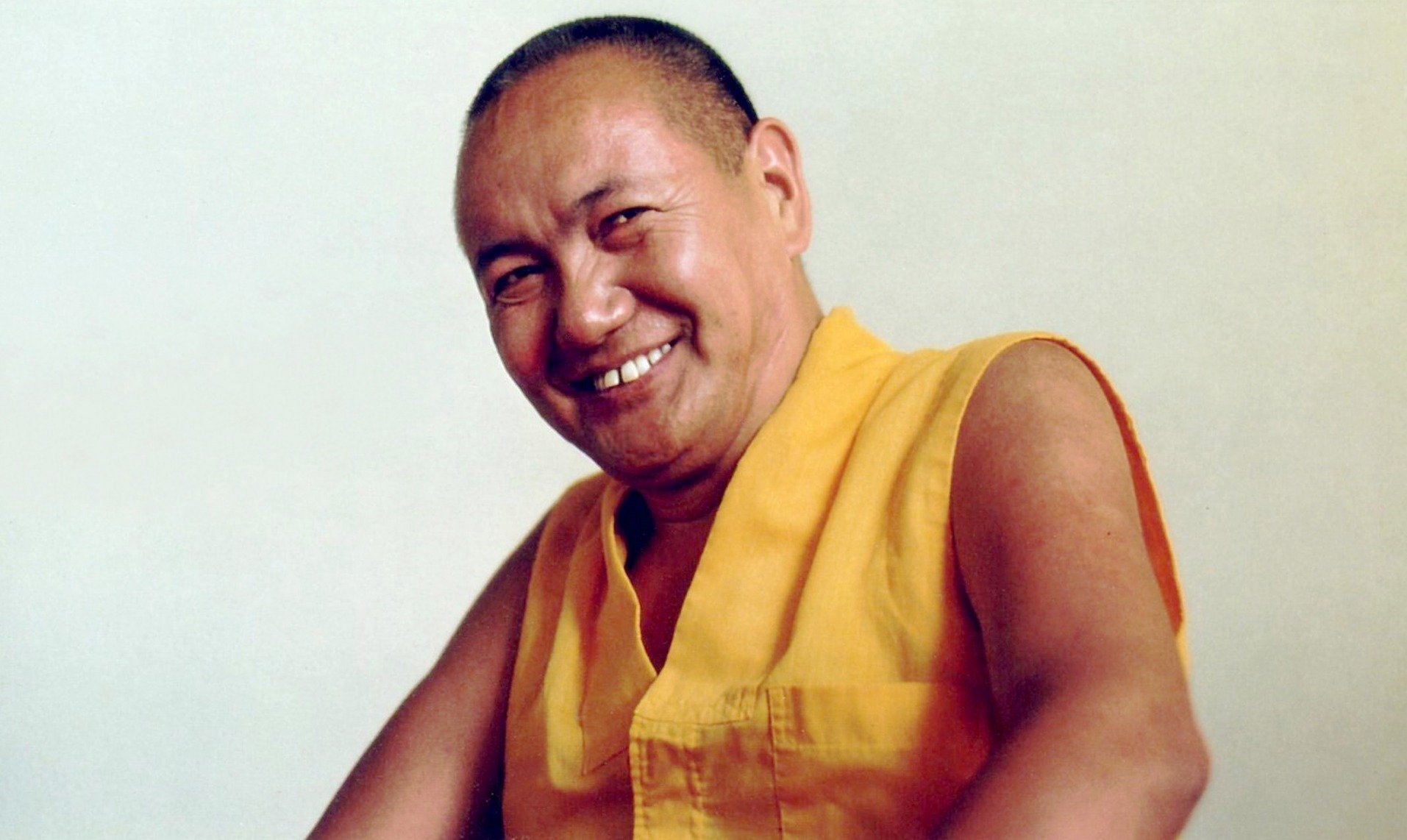
Some twenty minutes before dawn on the first day of the Tibetan New Year—March 3, 1984—the heart of Lama Thubten Yeshe stopped beating. He was forty-nine years old.

Lama had been seriously ill for four months, although according to Western medical reports since 1974, it was a miracle that he was alive at all. Two valves in his heart were faulty and because of the enormous amount of extra work it had to do to pump blood, it had enlarged to about twice its normal size. And he himself had said ten years before that he was alive "only through the power of mantra."

Here, Lori de Aratanha and Robina Courtin report the events leading up to and immediately following the passing away of this great yogi and teacher, an extraordinary man who moved the hearts of thousands during his fifteen brief years among Westerners.

Lama Thubten YesheEveryone who knew Lama Yeshe knew that 'he had a bad heart.' Yet it was only in November last year [1983] that they realized there was a serious danger to his life. A letter signed by three of his close students written on November 12th from Kopan Monastery in Nepal and addressed to all FPMT center directors reported that the observations of both Lumbum Rinpoche of Swayamhhu, Nepal, and Lama Zopa Rinpoche indicated that 'Lama will pass away within a year unless he takes time to do a long serious retreat and unless disharmony and division cease.' And Lama had agreed to accept a full long-life puja at Kopan at New Year the very day he eventually passed away.

Lama had arrived back in India in early October after a strenuous teaching tour of Europe and America. From Delhi he travelled to Dharamsala where he had a house in the grounds of the Tushita Retreat center. Here he stayed in seclusion.

Lama was not scheduled to go to Nepal to teach as he had done for fourteen years at the annual Kopan meditation course. Vicki Mackenzie, a London journalist and friend of Lama Yeshe for eight years, was at Kopan for the course. 'We were told that Lama was too sick. We didn't know where he was but we did know that he would not be coming. But, a couple of days before the end of the month-long course, suddenly. like magic, he appeared.

'It was morning. We all came out of the tent to greet him. It was so moving and terribly touching. All the small monks of Mount Everest Center were lining the road, the older monks on the roof of the gompa blowing conches and trumpets out over the valley. And everyone was so silent. There was such an incredible hush. Somehow it was very poignant and very holy. Lama Zopa went up to the land rover to greet Lama with unbelievable reverence, love just pouring out of him. Catherine and I, and others, burst into tears. It was so special and so moving.

'The silence was extraordinary. So unlike the usual joyful pandemonium of the monastery. We didn't know anything but somehow we felt that this was very, very special.'

And Lama Yeshe did teach. Two days later, at the end of the course, he gave first a question-and-answer session and the following day a four-and-a-half-hour teaching on refuge and bodhicitta.

'It was extraordinary,' said Vicki. 'For one month the hundred of us had been immersed in the serious business of a Iam rim course. It had been very intense. There had been much anguished discussion about the various traditional teachings Lama Zopa had been giving us.

'When Lama walked in I knew immediately that he was very ill. Still so caring though, and joking: "Oh. I don't know what I'm talking about!" But always so kind, so concerned about us. "Are you all right? Are you tired?" he would ask us. He showed just so much love.

'His answers were marvelous, somehow exactly what we needed. He completely demolished all our dualistic, narrow concepts. "Your Mickey Mouse minds! You are so boxed in, so narrow," he said. Somehow, his words were like a miracle. He spoke such utter common sense, made everything seem so simple. Our confusion and worries simply dissolved away. He knitted everyone together, cut across all divisions.'

  With Vicki Mackenzie, Kopan, December 10, 1983.Vicki had to leave Kopan the next day, so after his final talk she followed him out of the gompa to say goodbye. 'I was completely overwhelmed by his extraordinary kindness. He was obviously so ill, yet he showed only concern for me. "Are you all right dear? What can I do for you?" "No!" I said. "What can I do for you Lama?"

'He said he was fine. He took my hands and before leaving asked me to "give my love to all my dharma brothers and sisters in England."

'Lama had told me in an interview in 1978 that he "should have been dead years ago. But if someone tells you you're going to die, what can you do but give up? I don't give up," Lama said. "What these doctors don't see is that human beings are something special. We are beyond the ordinary concepts of what we think we are." That night, December 10th, Lama began vomiting and experiencing difficulty in breathing. He did not sleep, nor did he sleep the next night. On the morning of the 12th it was decided to take Lama to Delhi for urgent medical treatment.'

He traveled to Delhi with Karuna Cayton, an American student of Lama based at Kopan, and was admitted into the intensive coronary care unit of a good hospital. He stayed altogether for fifteen days under the close observation of two highly respected cardiologists. On January 1st Lama was released and remained another month in Delhi to recuperate.


On January 3rd Lama allowed—for the first time, according to Lama Zopa—mandala offerings to be made to him for his long life. On behalf of all his students, Australian monk and director of Lama's Dharamsala retreat center Max Redlich fervently requested Lama to live longer. Lama agreed that he 'could live for another two years.' He told Lama Zopa at this time that he 'could live for ten, twelve years, but it depends on the karma and hard prayers of the students.'

Since Lama had left Kopan on December 12th he had insisted that Karuna keep complete silence about his condition. In early January, Geshe Rabten, one of Lama's dearest teachers, stayed with him in Delhi. He instructed Lama 'to lift your cloak of silence. You should let people know about your condition so that your students can create merit.'

On January 8th Karuna wrote a letter to Lama's students at his centers detailing the past month's happenings.

Lama's heart was now failing so badly that congestion in his heart was making breathing difficult; congestion in his liver and other abdominal organs were causing pain and vomiting.

By early February it seemed clear that Lama should undergo surgery to replace his faulty heart valves. Stanford Hospital in California was chosen.


Lama Yeshe arrived at San Francisco Airport, two hours from Stanford, on February 3rd. He was accompanied by Lama Zopa, who had been with him constantly for the past month, American nun Max Mathews and his Indian doctor. He was met by John Jackson, director of Lama’s California center, Vajrapani Institute. Lama looked 'weak and surprisingly thin,' but still had his vibrant smile. He was driven straight to Stanford Hospital.

Registered nurse and student of Lama Yeshe, Shirley Begley, volunteered her services. She arrived at Stanford on the sixth. The results of the extensive tests on Lama confirmed previous diagnosis, and doctors suggested surgery as soon as he was strong enough.

On February 8th Lama was released from hospital and allowed home, where he would have full-time nursing care: Shirley would be joined later by Lennie, another nurse, Barbara Vauier and others.

Lama was driven to his home in Aptos, an ocean-side suburb of nearby Santa Cruz forty-five minutes from the Vajrapani land. The house, overlooking vast expanses of the Pacific, had been bought for Lama and renovated by some of his students.

He preferred to be home. He enjoyed his garden, and within two days was pottering around outside. But by the twelfth Lama was feeling faint and could no longer hold food down. He remained in bed and needed constant nursing.

Shirley was worried. Her medical experience told her that definitely Lama should be back in hospital, but he did not want to go. 'I don't need to go,' he said. 'You don't have to worry.'

Throughout the entire period of Lama's illness, Lama Zopa was in constant touch by phone with Kyabje Song Rinpoche in Switzerland as to when and how to act for Lama's benefit. He also consulted frequently His Holiness Dudjum Rinpoche in Paris. And he himself would always make observations in the traditional manner whenever decisions were needed.

Often, this proved difficult for the nurses: their observations as nurses told them one thing and Lama Zopa's would tell them another. However, they learned, they said, to let go and in retrospect can see the benefits of the decisions that were made.

On the evening of February 15th, Shirley was in the kitchen with Rinpoche. Lama was asleep in his room. Shirley was explaining to Rinpoche her perception of the seriousness of Lama's condition. Understanding the importance of Lama Zopa in the decision-making process, she wanted to clarify with him just how much responsibility she had. She asked Rinpoche if she could make the decision to hospitalize Lama if an emergency situation arose. 'You mean to save Lama's life?' Rinpoche asked. 'Yes,' said Shirley. Rinpoche agreed that she could.

Just then Lama's bell rang from his room. They rushed to him and it was immediately obvious to Shirley that Lama had had a stroke. She took his blood pressure and Rinpoche gave him some Tibetan medicine. Rinpoche agreed they should call an ambulance, which arrived five minutes later and rushed Lama to a nearby hospital. The stroke was severe. The left side of Lama's body was paralyzed. In spite of this, and against his doctor's advice, after one night in the hospital Lama insisted on going home.

During the next two weeks, Shirley, Lennie and Barbara nursed Lama around the clock. Many students worked continuously. Everyone was very happy to he able to serve Lama. They would feed, clean and massage him. Barbara said she could feel how utterly relaxed Lama was, quite unlike the way an ordinary person would be under the same circumstances, of this she was sure.

  Lama in Delhi with his Chihuahua Lama and Pekinese Yeshe, late December.Throughout the days, the conversations with Lama were brief; he did not speak much. Lama used short sentences and spoke directly. They learned how to be sensitive to his movements and learned how far they could go in their caring for him. At first they were hesitant about touching his body or wiping away perspiration and mucous. But Lama let them do everything. All of them felt incredibly grateful for this opportunity to repay Lama's kindness to them. They told him this, and said that he was a mother and father to all his students.

Throughout the days, of course, the students with Lama were continuously praying. As were his students around the world; Lama Zopa had given special instructions to all the centers.

Rinpoche discovered that he'd been carrying a Tibetan text on how to deal with paralysis. There were specific prayers and mantras to do in order to protect against more paralysis and reverse what already existed. It explained what food and exercises were suitable. Rinpoche instructed the people looking after Lama to say the mantra, om dumbali dumbali su su shey shey soha, loudly so that Lama could hear it and that they were to get him to repeat it seven times. The text also said that there should not be sparkling sunlight or mirror reflections in the room, so during the daylight hours Lama's room was kept dim.

  With nurse Shirley Begley.As the days passed, Lama's paralysis seemed to improve. However, his overall condition was weakening. Song Rinpoche was consulted about whether or not Lama should return to hospital. He advised that, no, Lama should stay at home for the time being, and that he himself would come to see Lama soon.

Song Rinpoche arrived from Switzerland on February 20th and stayed with Lama for three days. He performed many pujas and gave Lama initiations. By the twenty-sixth, however, three days after Song Rinpoche had left, Lama worsened. He was vomiting continually and was considerably weaker.

At Lama Zopa's request, Dr. Don Brown, another student of Lama's, came to examine him. Immediately Don recommended that Lama go to hospital to receive intensive care. He was taken to the Presbyterian Hospital in San Francisco. After tests, it was concluded that Lama must have surgery as soon as his strength could be built up.

It was agreed that neither Stanford nor the Presbyterian Hospital was the place for the necessary heart surgery. After much brainstorming, and observations by Rinpoche, Cedars-Sinai Medical Center in Los Angeles was decided upon; this was confirmed by Song Rinpoche in Switzerland.

Meanwhile, Lama's strength was gradually building up, as he was being intravenously fed. And his paralysis was remarkably improved. Plans went ahead to have him moved to Los Angeles. Max Math—Lama called her 'Mummy Max'—organized an air ambulance, a helicopter, to take Lama on the five- hundred mile journey south. He was accompanied by a cardiologist, Lennie and Max, and met at the hospital three hours later by long-time student John Schwartz.

He was placed in the coronary care unit. The hospital and Lama's doctor there, Steven Corde, were incredibly kind. In spite of regulations they allowed people to stay with Lama continuously. Characteristically, Lama treated Dr. Corde as if he were an old, dear friend.

Steven Corde told Rinpoche and Lennie that Lama's condition was critical, 'like walking on a cliff.' But he felt there was hope. Rinpoche asked him what he would do. Dr. Corde explained a procedure for strengthening the heart and prefaced his answer by saying, 'If he were a member of my own family I would...' Rinpoche said, 'Doctor, this is the last hospital we will go to. You seem to understand Lama and his case, so, as you would do for your own family, please you do for Lama.' And he requested to be informed about any crucial decisions so that he could 'check up.'

As in all the hospitals, the medical staff were told about the Tibetan Buddhist attitude towards the death process and, as everywhere, Steven Corde and the staff of the Cedars-Sinai were sensitive and understanding.

That night, and the following, March 2nd, the last night of Lama's life, Rinpoche and Thubten Minimal, a young Sherpa monk from Kopan who had served Lama for years, stayed with Lama. Also with them on the last night was Vajrapani resident, Chuck Thomas.

With Song Rinpoche, February 22, 1984.Nine years ago, in a conversation with Chuck about his heart, Lama told him that doctors believed he should be dead. He said that he was alive because of his psychic power and that when the time came to go he would just go; that it would be as simple as that. After his stroke Chuck asked Lama if he remembered that conversation, and Lama said yes, he remembered it clearly, and that now was the time. That was fifteen days before Lama came to Cedars-Sinai.


Chuck spent ten hours with Lama on the eve of his passing. He said Lama was completely conscious, talking and laughing with the nurses. He ate strawberries and talked about those that he grew in his garden. Some of his Los Angeles students visited Lama. They said he was as kind as ever, sending love to everyone.

In the middle of the night Rinpoche sent Chuck out to rest, then to make torma offerings and White Tara pills: Rinpoche intended to offer Lama a White Tara empowerment on the morning of Losar, the Tibetan New Year.

Around three-thirty or four in the morning Lama asked Rinpoche to do the Heruka sadhana with self- initiation with him. Lama was able to sit up for the meditation. Two students in the room as well were reciting White Tara mantras.

The moment Rinpoche had finished the Heruka sadhana Lama's heart beat changed; it could be observed on the monitor. It beat faster, then slower, and his breathing changed. A nurse came in and asked Lama if he was all right. ‘Yes,' he said. Was he hurting? 'No.'

Barely twenty minutes before dawn, at seven minutes past five on the first day of the new year, Lama Yeshe's heart stopped. Rinpoche immediately checked with Song Rinpoche whether or not to attempt resuscitation; he said yes. A team worked on Lama's heart for two hours. Steven Corde reported to Lama Zopa that there was no response. Rinpoche asked, ‘Doctor, what is the longest time you have worked on someone after their heart has stopped?' 'Three hours,' he said. Lennie asked if he had had success. 'No,' he told her. Rinpoche said, ‘I think it is time to stop."

From that point on no one was to touch Lama's body. Geshe Gyeltsen, who has a center in Los Angeles, arrived at Cedars Sinai. He and Rinpoche performed pujas at Lama's bedside, and students were told to do Heruka mantras. Meanwhile, a room on another floor was being prepared for Lama's body.

At eleven o'clock two orderlies gently wheeled Lama's body, covered in his saffron robes, through the hospital corridors in a silent procession. Rinpoche had permission to keep Lama's body there till ten in the evening.

Rinpoche and the students set up the quiet corner room as a sanctuary, making an altar on a bedside table and placing blankets on the floor for people to sit comfortably. When things were settled, Rinpoche stood before Lama's holy body and, with what one student called 'exquisite devotion,' made three full length prostrations before sitting.

People sat with Lama throughout the day, always reciting mantras. Just after five-thirty in the evening Rinpoche broke the utter silence in the room by suddenly shouting Heruka mantras. Chuck thought he noticed Lama's head move slightly under the covering robes, but felt he must have been hallucinating. But Rinpoche bent down to him and said, 'Now Lama's meditation is finished.'

Earlier in the day Lennie had made arrangements with a local mortuary, Abbott and Hast—recommended by the hospital as a mortuary that 'took pride in catering to special-interest, religious and ethnic groups'— to take Lama's body from the hospital. Mr. Hast was located on a yacht in the Pacific performing a burial at sea.

He was very kind. He arranged from there the appropriate formalities for obtaining permission from the governor's office to perform the cremation on the Vajrapani land: observations had found that either Vajrapani or Dharamsala would be most suitable.

Although it was a Saturday afternoon there were no hitches: permission was granted and a fire permit issued by the Boulder Creek environmental office, for which someone there graciously offered the two dollar fee.

Lama's body was moved that night to Mr. Hast's mortuary. Rinpoche was given special permission to spend the night there. Students who had spent sleepless nights at the hospital were encouraged by Rinpoche to go home. Others came to sit through the night with him and Thubten Monlam.

The room was large with comfortable sofas and pillows and chairs. Lama's body was at one end of the room and was covered with his saffron robe, a bouquet of white carnations at his feet. The overhead light was dim and the soft flicker of candlelight gave a most serene and peaceful atmosphere. There were hot plates for boiling water, and tea and tsog offerings from the hospital pujas were plentiful. Rinpoche suggested that people make prostrations and recite the practice to the thirty-five buddhas.

During the night, Rinpoche left the room to make phone calls. One was to request Song Rinpoche again to come to California from Switzerland, this time to oversee the cremation of Lama's body. Later, when he heard that he would come, he smiled and said, 'It will be good for the students.' At eleven in the morning of Sunday March 4th Lama Yeshe's body was taken from the mortuary and driven north to Vajrapani by one of the residents, Tom Waggoner, accompanied by a caravan of cars.

The journey took fourteen hours. At one in the morning of Monday they wound their way slowly up the dark bumpy road from the town of Boulder Creek into the huge redwoods of the retreat center. Residents and retreaters were lining the path to the gompa, and the sounds of conches, bells, damarus and chants, resonating into the night sky, greeted the cars as they approached.

The closed coffin, draped in white offering scarves, was placed by the altar at the front of the gompa, where it would remain until Wednesday afternoon, the eve of the cremation itself.

The news of Lama's death had started to spread around the world on Saturday morning. Although it was well known that he had been gravely ill, the fact of his death was stunning, almost impossible to take in. An Australian nun said that the last time she saw Lama, in Italy five months before, he had seemed like an old man, needing help to walk and scarcely able to breathe. 'If it had been any other person of the same age I would have known they were close to death; but somehow, because it was Lama, I just couldn't, wouldn't allow my mind to grasp it.'


Lama's coffin at Vajrapani


Venerable Lama Thubten Yeshe
1935-1984


By Monday morning Californian time—Monday night in Europe and Tuesday morning in Australia—the news had hit home. Scores of people, from Australia, New Zealand, India, Nepal, Malaysia, Hong Kong and many European countries, had already arrived or were on their way to Vajrapani .

Already, Geshe Sopa had arrived from Wisconsin and Geshe Thinley, one of Lama Yeshe's brothers, had come with five others from Australia, where he was resident teacher at Chenrezig Institute. And Kyabje Song Rinpoche was due from Switzerland that night, to officiate at the week-long ceremonies. Also there were Geshe Gyeltsen from Los Angeles, Geshe Lobsang Gyatso, the resident teacher at Vajrapani, and the reincarnation of his teacher from Sera Je, Tenzin Sherab, a young Canadian boy, and Jeffrey Hopkins and Elizabeth Napper from the University of Virginia.

American monk Thubten Pelgye and others had started to organize the kitchen, bringing in food enough to feed one hundred people for a week. And forty-five minutes away, not far from Santa Cruz and Lama Yeshe's house at Aptos, Peter O'Donnell and the staff of Greenwood Lodge, a conference center and home of the Universal Education Association, had opened up their rooms and cabins to accommodate the visitors.

On Monday night Song Rinpoche was picked up from the San Francisco airport and taken to Lama's house, where he would stay until Saturday March 11th. There with him were Lama Zopa, Geshe Thinley, Geshe Gyeltsen and Geshe Sopa. They were being looked after by Thubten Monlam, the young Sherpa monk whom Lama had sent for from Kopan a month before, and Lama's friend, Age Delbanco. By Tuesday afternoon, the gompa was packed. There was a Vajrayogini puja and self-initiation, and in the evening a Heruka Vajrasattva tsog offering written by Lama Yeshe in 1982, with prostrations to the thirty-five Buddhas being performed alternately. As much as possible, Lama Zopa had said, these purification practices should be done—'not for Lama's sake but for our own.'

People continued to arrive during the week. Although many had not met before, there was a powerful feeling among everyone of deep friendship; brothers and sisters sharing the grief of losing an incredibly loved parent.

Lama Zopa asked Geshe Sopa to talk to the people on Wednesday morning. 'We have known each other for a long time, as teacher and student, since he was a young boy,' he said. 'During these past years Lama Yeshe has done so much beneficial activity for so many people, especially in the West.'

Geshe Sopa emphasized harmony. 'There are many students everywhere at all the centers that Lama Yeshe and Lama Zopa have established. It is so important to be very 'friendly towards each other, like children of the one spiritual father...We should ask. "How can I help?"'

Lama Yeshe is gone, but 'Lama Zopa is still here. His activities everywhere are great, sowing seeds everywhere for the development of this wonderful spiritual teaching that is most beneficial to sentient beings.'

After the talk, an all-day Heruka puja and self-initiation started. And John Jackson and others, with the supervision of Song Rinpoche, began work on the stupa in which Lama's body would be burned. The site chosen was a clearing on a ridge, five minutes' walk up from the gompa, which had a spectacular view of miles of forest and the smell of the unseen ocean beyond.

Building the cremation stupa. Building the cremation stupa.
Prayer flags.

Keeping vigil at Lama's body next door was Bill Kane. 'Beautiful odorous were coming from his body,' he said. On Wednesday morning he assisted Lama Zopa and others prepare Lama's body for cremation. It was to be burned in an upright position, so his knees were drawn up to his chest and tied tightly with katas. His arms were crossed and a dorje and bell placed in his hands. He was dressed in his magenta robes and a yellow chogo. Upon his head was placed a triple-tiered black bodhisattva's hat adorned with a crystal rosary, and his face was covered by a red cloth. His body, in a chair, was driven in procession up to the ridge, which was already prepared for the fire puja.

Mountains of appropriate offerings for the fire were on a side altar, between the stupa and Song Rinpoche's throne. The place was covered in flowers. Incense wafted on the breeze and the sky was bright and blue. Two hundred people were assembled—monks, nuns, lay men and women, and children and included five of Lama Yeshe's doctors, members of the administration of the University of Santa Cruz where Lama had taught for a term in 1978, and many, many friends. One, a woman who 'always dresses in red' had met him five years before and was immediately attracted because of his 'wonderful laugh.' That morning she had heard that 'Lama Yeshe was in town' so came to Vajrapani with an offering of flowers— only to discover that she was coming to his cremation.

The van carrying Lama's body stopped at the edge of the crowd. His body was carried to the stupa—only the square base of which, waist high, had been built so far—and carefully placed inside. Metal rods were put horizontally on all sides of the body to keep it upright. Firewood was stacked around him and oil poured over the wood to ensure that the fire would burn well.

The remainder of the stupa was built around Lama's body. Bricks were laid in a circular fashion to form a cone-shaped structure about eight feet tall. The entire stupa was covered with mud and, as it dried, with white wash. The square base had four openings, one on each side, and the upper part two, for receiving the offerings.

Bringing Lama Yeshe's body to the stupa. Gathering for the puja.
Preparing Lama's body for cremation. Preparing Lama's body for cremation.
Completing the cremation stupa. Whitewashing the cremation stupa. Everyone gathered for the puja.

The person elected to start the fire had to be someone who had not received teachings from Lama. She prostrated three times in front of the stupa, bent low and, with a burning torch handed to her by one of the attendants, set fire to Lama Yeshe's body.

The Yamantaka fire puja commenced. The mountain of offerings slowly diminished as the ingredients were handed to Song Rinpoche who in turn handed them to Chuck Thomas and others who offered them to the fire. The puja lasted three hours. Throughout, a deep stillness, a composure, a sense of the unexpressed grief, pervaded. And the only sound to be heard above the chanting was the blazing of the powerful fire.

By one o'clock the puja was over. Later, Song Rinpoche and Lama Zopa returned to the stupa to seal the openings; it would remain untouched until Sunday afternoon when Lama Zopa would dismantle it and remove the relics of Lama's body.

Lama Thubten Zopa Rinpoche and Geshe Gyeltsen

Song Rinpoche

Ven Max Mathews offering a kata to Song Rinpoche


Starting the cremation fire.

The puja

The cremation.


Beginning the cremation.

The cremation


The cremation

Nightime at the stupa.

I'm just very numb,' Lama Zopa said later that afternoon, when he talked briefly in the gompa. 'I can't think of anything.' Rinpoche sat for a full five minutes before continuing. 'These high lamas, His Holiness and all these high lamas, including Lama Yeshe, they do not fit us, they do not fit. Because of our small merit, they just do not fit. They are like a huge burden that we cannot carry.' Earlier. he had said that Lama had died 'because we do not have the merit. But we should not think too much about this because we would go mad. Instead, we should protect our mind and try to practice dharma.'

It seemed that people hung on to his every word. Lama had always been the pillar of strength; now, with him gone, people looked with a sense of relief almost to Lama Zopa. He thanked everyone for their kindness during the past few months. 'If we follow Lama's wishes, every piece of advice, if we put it all into practice then I think it will become a quick cause for Lama to reincarnate soon. Maybe he will even come to America! I think that's all.' he said. 'I will pray.'

By Friday, many people had left. In the afternoon Song Rinpoche gave a Heruka Vajrasattva initiation and talked briefly. He, like the other lamas, stressed harmony. 'We are all very good relatives,' he said. 'Loving each other is the most important thing.'

Kyabje Song Rinpoche was bade farewell—for what would be the last time—at the airport on Saturday, when he returned to Switzerland. That night Lama Zopa invited people to Lama's house for a Lama Choepa puja. The room was packed. The ocean pounded just outside the windows. It was good to be there in that house that Lama had loved. The puja, sung in English, was intense and heartfelt. It was seven days since Lama's death.

On Sunday afternoon, Lama Zopa went back up to the ridge to open the stupa and remove the relics. He requested that everyone stay in the gompa and recite Vajrasattva mantras and do prostrations. Tenzin Sherab, the young Canadian Rinpoche, was there with Lama Zopa. 'First we did prayers, then more prayers,' he said later. 'We started opening the stupa at exactly two-fifty p.m. and at four-twenty-four we finished taking everything out.

First, the stupa had to be carefully dismantled, brick by brick. Each bone was taken from the stupa floor and handed to Lama Zopa, who would examine it and put it aside in the red trunk bought especially for the relics. The ashes were put separately.

Later, Rinpoche said that the fire had been almost too good; it had burned so fiercely that most of the body had burned completely. What remained, apart from the bones, were part of Lama's heart and kidneys. 'I saw every bone in his body,' Tenzin Sherab said. Later, during the drive down to Santa Cruz, he said that during puja after taking out the relics he looked up into the sky and saw, besides other things, 'a cloud forming into an arrow and pointing towards the south, and four Tibetan letters, la, la, sa and ra. ' Song Rinpoche suggested that these might indicate the name of the mother of Lama Yeshe's future incarnation.

The relics were carried in procession down to the gompa where again purification practices were done. Rinpoche thanked everyone at the conclusion of the puja. 'I am completely satisfied. Everything has gone so perfectly, nothing inauspicious has happened.' He said that even if the pujas had been done by the monasteries in south India, it all could not have gone better. He gave to each person a capsule of ashes — 'vitamins for the mind,' he called them.


By Monday afternoon, Vajrapani land had returned to its normal serene routine. The week that had seen one of the most extraordinary events of the centre's seven years of existence had come and gone like a dream. Lama Zopa had returned to India that morning, via Switzerland where he would see Geshe Rabten and Song Rinpoche, and the people had returned to their homes and centers and monasteries around the world.

Lama's relics, once consecrated by Song Rinpoche in Switzerland, were divided up and sent to each of the centers, where they were received with great respect and ritual 'as if you were receiving Lama himself,' Rinpoche had advised. Most of the relics, however, went to Kopan where eventually they will be sealed inside a larger-than-life-size statue of Lama; the face, an exact likeness, is being made by American sculptor Courtland Bennett, and the body, with the hands in Vajrasattva mudra, by local Nepali artists.

A thousand small statues of Lama Yeshe, commissioned by Max Mathews, are being made in India, and the bulk of the ashes from the cremation will be mixed with clay and made into small Vajrasattva statuettes (tsa-tsa).

In accordance with Lama Yeshe's own wishes—that a year's Heruka Vajrasattva retreat be done 'wherever my body is'—a retreat started at Kopan in April. A yearlong retreat also commenced mid-year in Spain, at the O Sel Ling Retreat Center.

It is possible for people to come to these retreats for any period of time. Most other centers have held or plan to hold shorter retreats at times to suit their students.

While preparing Lama's body for cremation, Bill Kane asked Rinpoche if Lama had ever indicated to him where he planned to take rebirth. Rinpoche thought for a while before replying that no, Lama had never said any thing about it, but Rinpoche's own opinion was that Lama 'had karma with California.' Seven months later Rinpoche said in a letter to one of his students that in a dream he had seen that 'Lama had already decided on his rebirth.'

And in December he said, 'Lama will reincarnate soon. We have done many pujas and have been checking and will continue to check through lamas and deities. So sooner or later we can have big parties for Lama's reincarnation.'


back to top ^


back to top ^


An intimate look at the life of Lama Yeshe from friends and students